October 30, 2026
How to make classroom teams fast and fair
Quick, fair ways to split a class into teams for a game: mixed abilities, rotating speakers, team names and a class list that calls on every student.
Every teacher has lost ten minutes of a lesson to making teams. Students drift towards their friends, the two strongest end up together, someone is "always on the losing team", and by the time everyone is sitting down the bell is close. Good teams don't need to be perfect. They need to be quick to make, roughly balanced and fair to every student inside them.
Here is what works, from a 30-second version to a planned one, plus how to share out the talking once the teams exist.
Rule one: make teams in under a minute
The longer it takes, the more noise and negotiation you get. Pick a method that fits the lesson and stick to it.
- Rows or tables. The fastest option by far. "This row is Team 1, this row is Team 2." Nobody moves, and you can start straight away. In a class of 40 in fixed rows, this is often the only sensible choice.
- Count off. Go round the room: "1, 2, 3, 4, 1, 2…". Friends sitting together end up on different teams, which is half the point. Students then move, or stay put and remember their number.
- Planned teams. Make them before the lesson, write them on the board or a slide, and keep them for a week or a unit. It takes you five minutes at home and saves five minutes every lesson.
- Same teams for a while. Changing teams every lesson feels fair but costs time. Keeping them for two or three weeks builds team spirit and lets you fix problems once.
Whichever you choose, say it once, clearly, and start the game. Teams that start playing stop negotiating.
Mixing abilities without making it obvious
Balanced teams make better games: a close score keeps everyone trying until the last question. But students notice when you "share out" the strong ones, and nobody likes being the one who was shared out.
A few quiet ways to balance:
- Plan from your own notes. Rank the class roughly (privately), then deal the names like cards: 1st to Team 1, 2nd to Team 2, and so on, then back the other way. Nobody sees the ranking.
- Fix the obvious problem only. If teams by rows put four of your strongest students together, swap one or two. You don't need a perfect spread, just no team that wins every time.
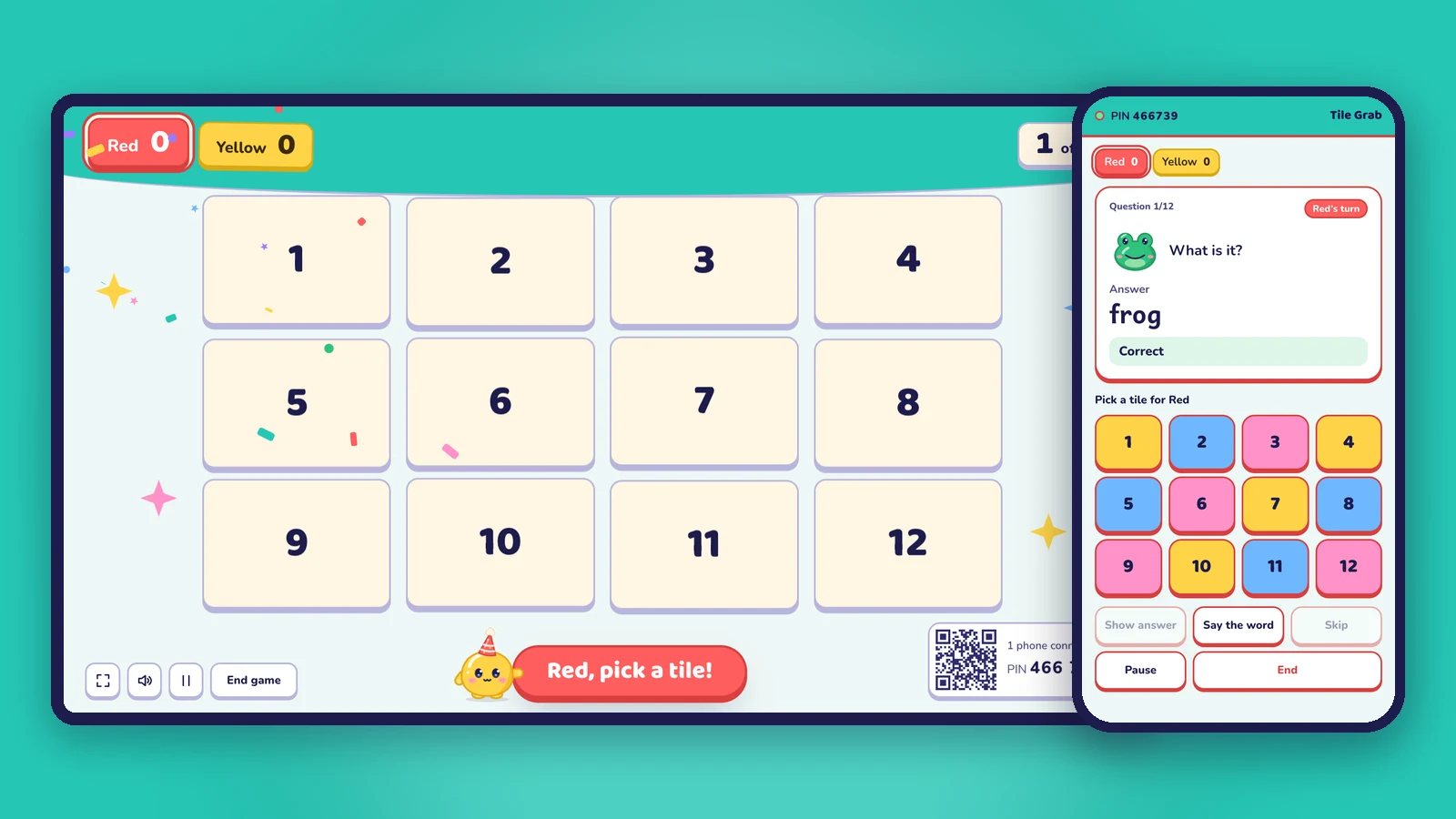
- Let the game balance the rest. Games with some luck keep weaker teams hopeful. In Paper Race the car in last place moves two steps instead of one, and in Tile Grab a star or a magnet box can change the scores in one turn. Your planning doesn't have to do all the work.
For a class that is very uneven, or that fights about teams no matter what, try a game with no losing team at all: in High Water every team builds the same tower against a rising sea, and the whole class wins or loses together.
Rotate the speaker
Balanced teams are not enough on their own. Inside each team, one confident student can still answer every question while the others watch. The fix is simple: the team thinks together, but one named student says the answer, and that student changes every turn.
You can do this without any tool. Number the students in each team (1 to 5), then call "Number 3s!" for the next question. Teammates help, but only the number 3 answers. Students who would never put up a hand will answer when it is their turn and their team is whispering the answer in their ear.
The class list in Oly
If you play in Oly, the Ready page has a setting called Call on students. Paste your class list, one name per line. When the game starts, Oly shuffles the names into the teams, and each question card names the student who answers for that team, for example "Team 2: Mia, your turn!". Each team goes round all of its members in order, so everyone gets a turn before anyone gets a second one.
A few practical notes:
- The mixing is random, and Oly doesn't print the full team lists before the game: each name appears on the card when that student's turn comes. It works best when students answer from where they sit and the team is simply the colour on the screen, which suits big classes in fixed rows. If your teams are tables you made yourself, number the students instead.
- It works in games where teams take turns (most of the 27). In the race games, such as Listen and Touch, any student can run to the board, so choose the runner yourself.
- The list stays on your device. It is saved in your browser for next time and never sent to Oly's servers, even when you're signed in.
Let teams name themselves (quickly)
Team names are a small thing that matters to students. A team called "The Pandas" cares more than "Team 3". But naming can also take ten minutes and end in an argument.
- Give a time limit. "You have one minute to agree on a name. No name, and you're Team 3." It works almost every time.
- Give a theme. Animals, planets, foods, words from today's lesson. A theme speeds up the choice and avoids names you would rather not see on the big screen.
- Use the colours. Younger classes are often happy to be "the red team" and "the blue team". In Oly every team already has its own colour, and the default names are simply Team 1, Team 2 and so on.
In Oly you type the names on the Ready page or in the lobby, and you can change them during the game from the ⚙︎ button if a team comes up with a better name halfway through.
How many teams?
- 2 teams make a strong rivalry, but a big class means 15 or 20 students per team, and most of them wait. Good for a short head-to-head like Tug of War.
- 3 to 4 teams are the sweet spot for most classes of 20 to 30: small enough to talk, few enough that turns come round quickly.
- 5 to 8 teams suit big classes, so each team stays at five or six students. With many teams, turns come round slowly, so pick a game where every team plays every question, such as Team Bingo or Ring the Bell.
Oly's free plan plays with 2 to 4 teams; Oly Pro allows up to 8.
A team routine you can run tomorrow
- Teams by rows, or the teams from last week. Under a minute.
- One minute for team names (optional).
- Students in each team number themselves, or you paste the class list.
- Explain the rule once: "You can help, but only the named student answers."
- Play for 10 to 15 minutes.
- Keep the teams for the next game.
Want the rest of the routines (calm, rewards, review)? Start from the guide to classroom management games. To try it now, pick any game in the library and play it with your next class.