High Water: a cooperative classroom game the whole class plays together
A cooperative review game: the whole class builds one tower while the sea rises. Answer right to add floors, stay dry to win together. Free, one screen.
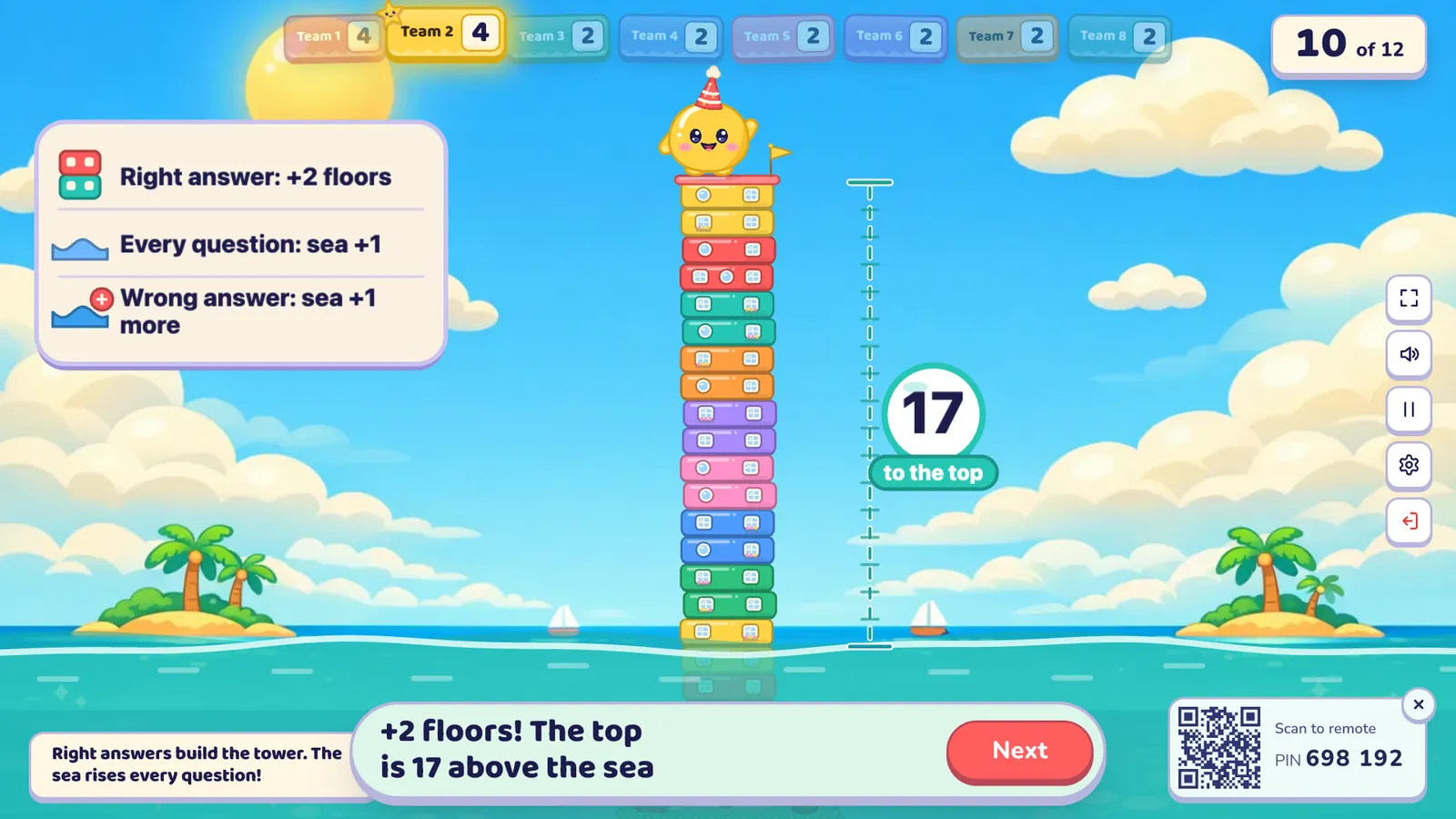
High Water is a cooperative classroom game: the whole class builds one tower on a tiny island while the sea creeps up. Every right answer adds two floors in the answering team's colour, every question brings the water up, and a wrong answer brings it up faster. If the class gets through the questions with the top still dry, everybody wins; if the water reaches the top, everybody loses. The real opponent is the sea.
At a glance
| Players | The whole class in 2–4 teams free (up to 8 with Oly Pro), all on the same side |
| Time | About 10–15 minutes for 12 questions |
| Works with | Every English question format and every subject (multiple choice, true/false, open questions) |
| Best for | Classes that get too competitive, team building, mixed levels, the first lesson with a new group |
| You need | One screen (projector, TV or interactive display) and your phone as the remote |
How to play High Water
- Make or pick a question set. Snap a textbook page, paste a word list, type a topic or your own questions, or open a set from the free library.
- Pick High Water, set the teams and start. The tower starts with three floors on an island. The longer the game, the higher the island, so the sea needs time to get there.
- Play. Teams take turns answering, but they all build the same tower. A right answer adds two floors in that team's colour. After every question the sea rises one level; a wrong answer makes it rise one more. A number beside the tower shows how far the top is above the water. Finish the questions with the top dry and the class wins together. If the water reaches the top, the game ends there and the sea wins this time.
Rules and scoring
- Right answer: +2 floors, and the sea rises 1. The tower gains one level on the water.
- Wrong answer: no floors, and the sea rises 2. The tower loses two levels on the water.
- The verdict is shared. The summary says "The class stayed dry!" with the tower's height, or "The water won this time!". Nobody is out and no team loses alone.
- Team points: each team scores the floors it built (2 for a right answer), and the colours in the tower show who built what. You can hide the score if you want the class to think only about the tower.
- Double and triple questions add 4 or 6 floors, a good way to give the class a lifeline near the end.
- Steal (off by default): after a miss, another team can answer the same question and build the floors. The sea rises only once per question either way.
- How hard is it? The game is balanced so that a class answering most questions right usually stays dry, and a class answering only one in three usually floods. With 12 questions, a class getting 6 in 10 right stays dry about seven games in ten.
- Also: a timer per question (10 to 60 seconds; running out counts as a wrong answer), wrong answers losing a point (off by default), a seasonal look and calm or no effects.
What you can teach with it
For English, every question format works: picture, word, listen, spell, meaning, sentence order and your own questions.
- Weather and nature at A1–A2: sea, island, wave, tower.
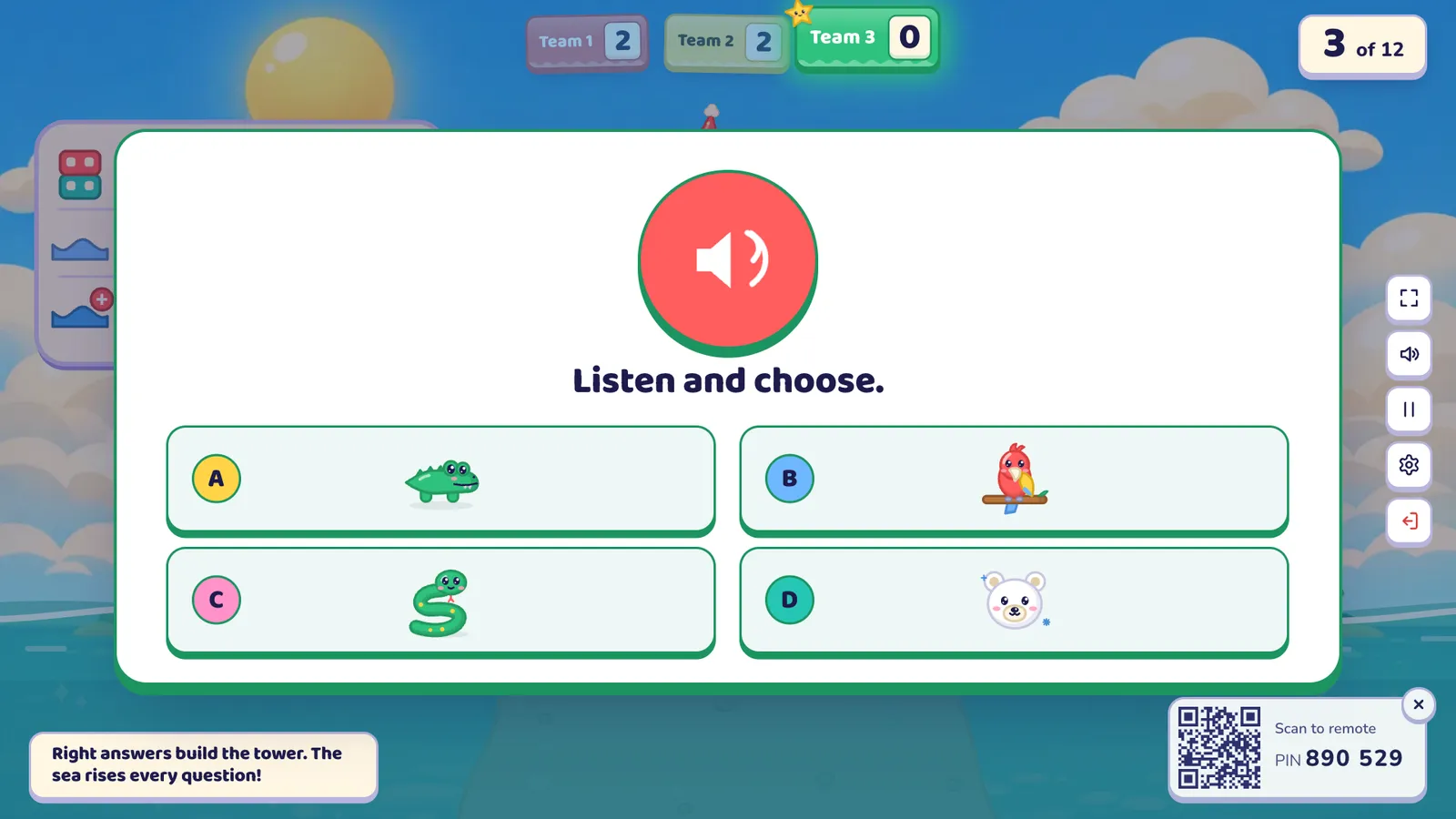
- Listening: listen questions, like the one above, where everyone has to hear the word.
- Comparatives: after the game, "Our tower is higher than the water", "The sea is rising faster".
For other subjects:
- Math: the number beside the tower is a live subtraction. Ask "how many levels if we get this one right? And if we miss?"
- Science: sea levels, the water cycle or climate, as true/false statements or multiple choice.
- History and geography: islands, coasts, rivers and floods, a good fit for the theme.
Tips from the classroom
- Use it with a class that fights over points. The teams still answer in turn, but they cheer for each other's floors.
- Talk about the gap. Before a hard question, read the number out: "We're 3 above the sea. Can we afford a miss?"
- Lost the first game? Play it again with the same set. The second try is usually dry, and the class sees its own progress.
- Big classes: with a class list, Oly names one student per team each turn, so everyone builds a floor.
Play it without a screen
- Draw a sea line at the bottom of the board and a tower of three boxes on an island a few levels above it.
- Ask a question; a right answer adds two boxes in the team's colour.
- After every question, draw the sea one level higher; after a wrong answer, one more.
- If the sea reaches the top box, the sea wins. Finish the questions above water and the class wins.
The screen version builds the tower, raises the sea and shows how far the top is above the water, all run from your phone.
Questions teachers ask
Is High Water free?
Yes. Playing is free with up to 4 teams, with library games and your own typed questions. The free plan also includes 10 AI question sets a month (3 from photos); Oly Pro allows up to 8 teams.
Do students need devices?
No. The class plays on one screen. You run it from your phone, or from the keyboard (C for correct, X for not yet, Space for the next question).
Is there a winning team?
The class wins or loses together. Each team still scores the floors it built, so you can show who built most, or hide the score and talk only about the tower.
Can a team lose points?
Only if you switch on "Wrong answers lose a point". A miss normally costs floors on the water, not points.
Can I use my own questions?
Yes. Paste them as question | answer | wrong, wrong, type them in the editor, or edit any set before you play.
For a game where every team answers every question, try Ring the Bell. For a calm game with cute prizes, try Fishing Pond.