Ladder Climb: a ladders and slides board game for the classroom
A ladders and slides board game for the classroom: answer right, roll the die, climb ladders, dodge slides, reach 30. Free, one screen, no student devices.
Ladder Climb is a ladders and slides board game for the classroom, in the spirit of the snakes and ladders game many children already know. Teams answer questions, and every right answer rolls a big die on the screen: land on a ladder and you climb, land on a slide and you slip back down. The first team to reach square 30 wins. It works with any subject and is a favourite with primary classes.
At a glance
| Players | 2–4 teams free (up to 8 with Oly Pro), the whole class |
| Time | 15–25 minutes for 20 to 30 questions |
| Works with | Every English question format and every subject |
| Best for | Primary classes, end-of-unit review, a board game feel on a projector or touch screen |
| You need | One screen (projector, TV or interactive display), your phone, and speakers for the dice |
How to play Ladder Climb
- Make or pick a question set. Snap a textbook page, paste a word list, type a topic, paste your own questions, or open a set from the free library.
- Pick Ladder Climb, set the teams and start. Every team's piece starts on square 1. Teams take turns answering.
- Play. A right answer lets the team roll the die (1 to 6) and move that many squares. A wrong answer means no roll. The first team to reach square 30 wins straight away; you don't need the exact number to land on it. If the questions run out first, the team furthest up the board wins.
Rules and scoring
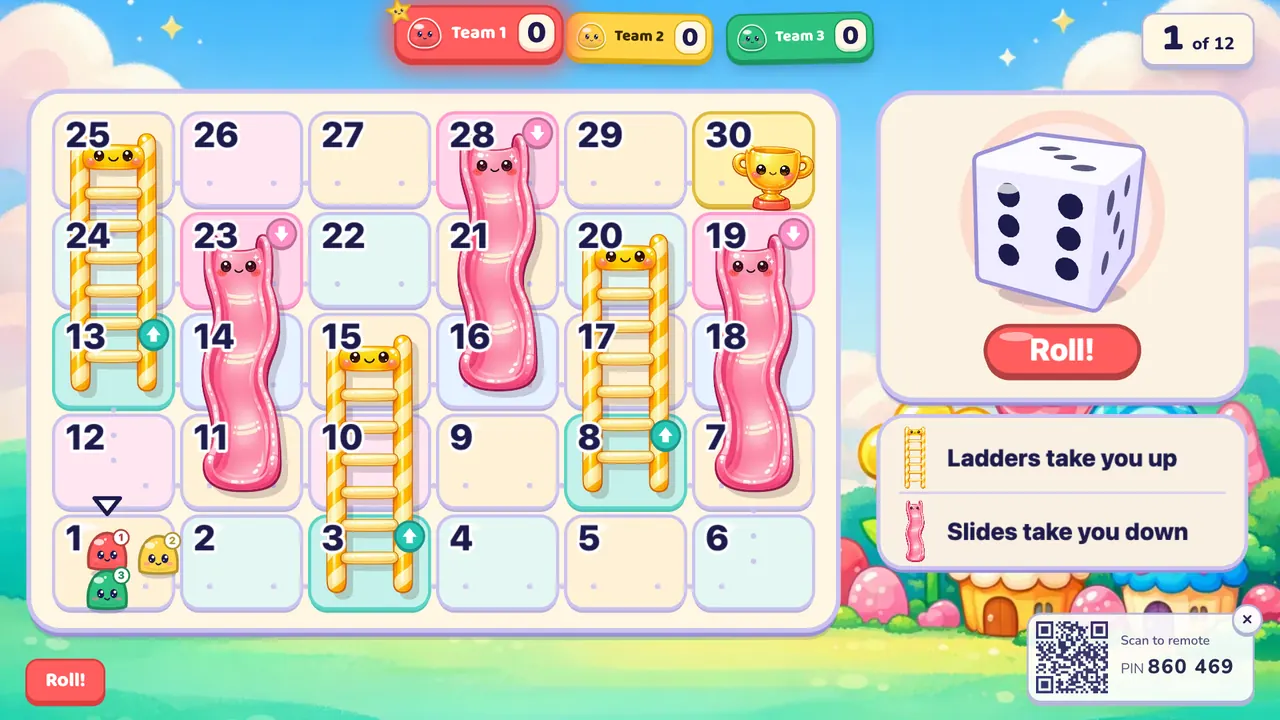
The board has 30 squares, numbered in a zigzag from the bottom left. Each ladder and slide runs straight up or down its own column, so the board is easy to read from the back of the room:
- Ladders: square 3 climbs to 15, square 8 to 20, and square 13 to 25.
- Slides: square 19 slides to 7, square 23 to 11, and square 28 to 16.
- Score: the score follows the piece. Moving up adds points; a slide takes them away. The team at the top of the board always leads the scores.
What you can switch on the start screen or during the game:
- Double or triple questions: mark a question in the editor and a right answer moves the piece double or triple the roll.
- Wrong answers lose a point: off by default. When it's on, a wrong answer moves the piece back one square.
- Steal (off by default): when you turn it on, after a miss another team can answer the same question and roll.
- Also: a timer per question (running out counts as wrong) and hiding the score for the whole game.
What you can teach with it
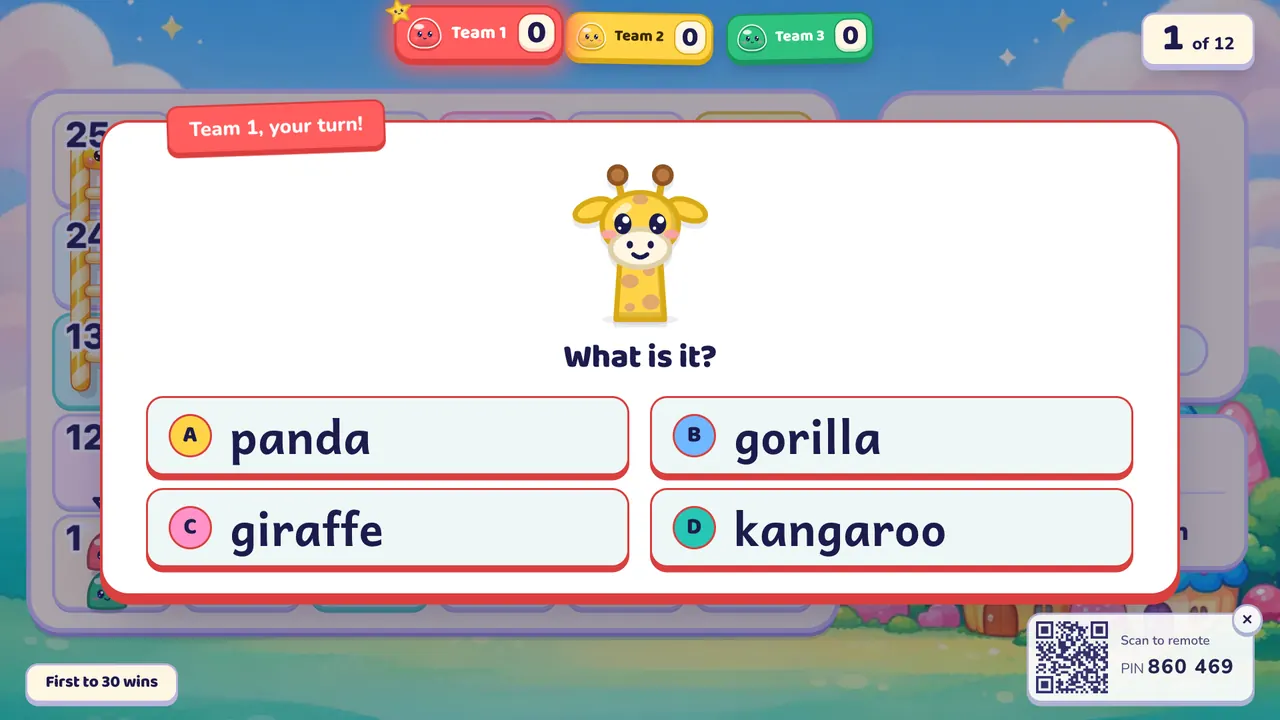
For English, Ladder Climb takes every question type Oly makes: picture, find the picture, listen and choose, the missing letter, the English word for a meaning, sentence order, and your own questions. Some ideas:
- Numbers and colors at Pre-A1: picture and listening questions; the class counts the squares out loud as the piece moves.
- Daily routines at A1: sentence order questions such as "up / I / at seven / get".
- Comparatives at A2: your own questions, "big → ?" with three wrong answers.
For other subjects, it plays multiple choice, true/false and open questions:
- Math: times tables, number bonds, or "what comes next" patterns.
- Science: true/false facts about the human body or the water cycle.
Tips from the classroom
- Use more questions. With 12 questions and 4 teams, each team rolls only three times; set 20 to 30 questions so someone can reach the top.
- Count together. Have the class count the squares aloud as the piece moves. For young learners it's free number practice.
- Call one student per team. Type your class list on the start screen and Oly calls a different student each turn.
- A team stuck at the bottom? Turn on steal: a right answer on another team's miss gives them a roll.
- Let students roll. On an interactive display, the student who answered taps Roll.
Play it without a screen
- Draw a 30-square grid on the board and add three ladders and three slides, each one inside a single column.
- Give each team a magnet or a colored mark on square 1.
- Ask a question; a team that answers right rolls a big foam die or a die under a visualiser, and moves.
- First team to 30 wins.
The screen version rolls and moves for you, follows the score, and lets you run the whole game from your phone.
Questions teachers ask
Is Ladder Climb free?
Yes. You can play it free with up to 4 teams, with library sets and your own typed questions. The free plan also makes 10 AI question sets a month; Oly Pro allows up to 8 teams and more AI sets.
Do students need devices?
No. The board is on one shared screen. Only you use a phone, as the remote, and the keyboard works too (C for correct, X for not yet).
Does a team need the exact number to finish?
No. Any roll that reaches or passes square 30 wins, and the game ends there.
Can a team lose points?
Yes, when its piece lands on a slide, because the score follows the square. If you switch on "wrong answers lose a point", a wrong answer also moves the piece back one square.
What happens if nobody reaches 30?
When the questions run out, the team furthest up the board wins. Set more questions if you want a race to the top.
How many students can play?
Any number. The class splits into 2 to 4 teams on the free plan, up to 8 with Oly Pro.
For more racing, try Paper Race or test your luck with Lucky Wheel.