Mini Golf: a classroom mini golf game for team review
A mini golf review game for the classroom: teams answer, pick one of five shots and putt for the cup (5) or a ring (3, 2, 1). Free, one screen, no devices.
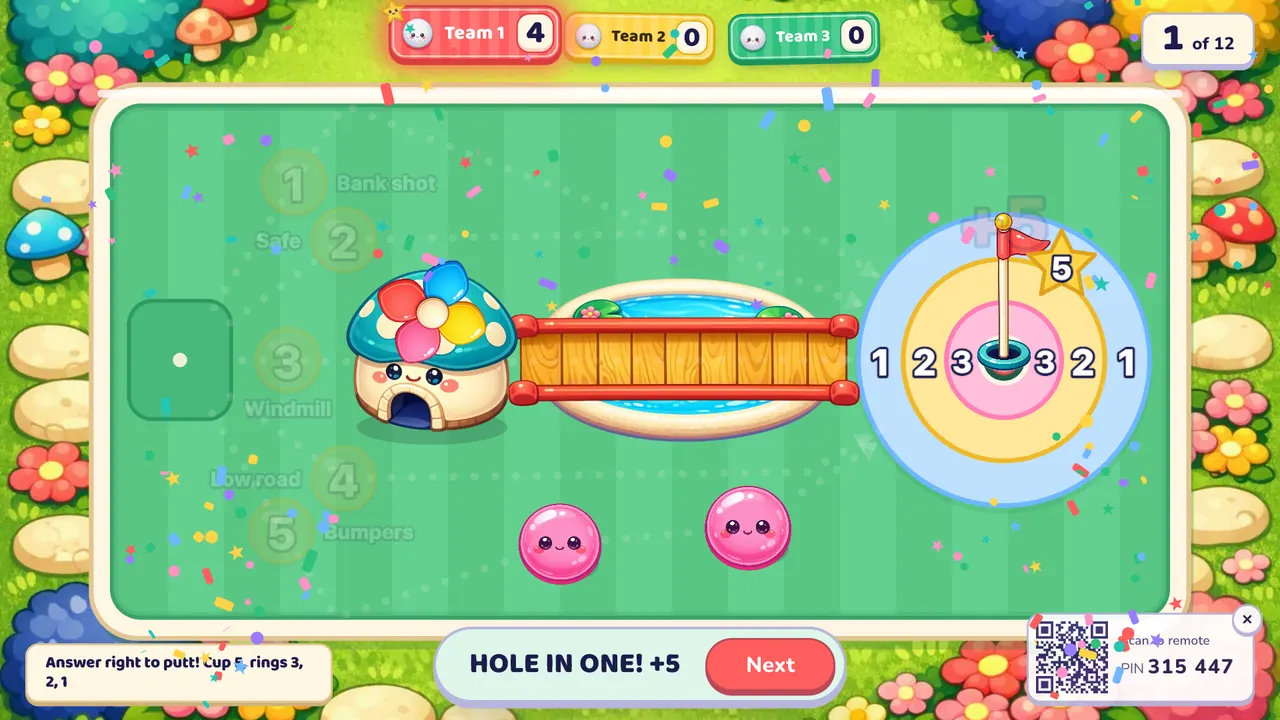
Mini Golf is a classroom mini golf game: a right answer earns a putt, the team picks one of five shots across a little course with a windmill, a pond bridge and jelly bumpers, and the ball stops in the cup or in one of the rings around it. Safe shots score steadily; risky ones can sink it for 5 or end with nothing.
At a glance
| Players | Whole class in 2–4 teams free (up to 8 with Pro) |
| Time | About 15–20 minutes for 12 questions |
| Works with | English (picture, word, listen, spell, meaning, order, custom) and any subject (multiple choice, true/false, open questions) |
| Best for | Review before a test, vocabulary, classes that like a strategy choice, touch screens |
| You need | One screen (projector, TV or interactive display) and your phone; speakers for the sounds |
How to play Mini Golf
- Make or pick a question set: type a topic, paste a word list or your own questions, snap a textbook page, or open a set from the library.
- Pick Mini Golf, set the teams and start. Teams take turns. Scan the QR code on the screen (or type the 6-digit PIN) and your phone becomes the remote.
- Play. The team whose turn it is answers. If it's right, the team picks a shot from 1 to 5 (tap it on the screen, on your phone, or press keys 1 to 5). The ball rolls and the points depend on where it stops. A wrong answer gets no putt. After the last question, the highest score wins.
Rules and scoring
- Where the ball stops: the cup is 5 points, then rings worth 3, 2 and 1 around it. Outside the rings, in the pond or bounced back by the windmill is 0.
- The five shots all score about the same on average (a little over 2 points), but they spread very differently:
| Shot | What it does | Hole in one | Scores 0 |
|---|---|---|---|
| 1 Bank shot | Off the top wall, down to the cup | 1 in 10 | 1 in 10 |
| 2 Safe | The top road, gentle and steady | never | never |
| 3 Windmill | Through the windmill and over the bridge | 3 in 10 | 4 in 10 |
| 4 Low road | Under the pond, past the bumpers | 1 in 10 | 1 in 10 |
| 5 Bumpers | Off the bottom wall into the jelly bumpers | 3 in 10 | 3 in 10 |
- Windmill is all or nothing: a blade can bonk the ball back, or it can fall off the bridge into the pond.
- Double and triple questions multiply the points, so a hole in one on a double question is 10.
- You can also switch on a timer (10 to 60 seconds; running out counts as a wrong answer), losing a point for a wrong answer, steal (another team can answer a missed question and take the turn's reward), hidden scores, seasonal themes and calm effects. A score never drops below zero.
What you can teach with it
For English, every question format works. Some ideas:
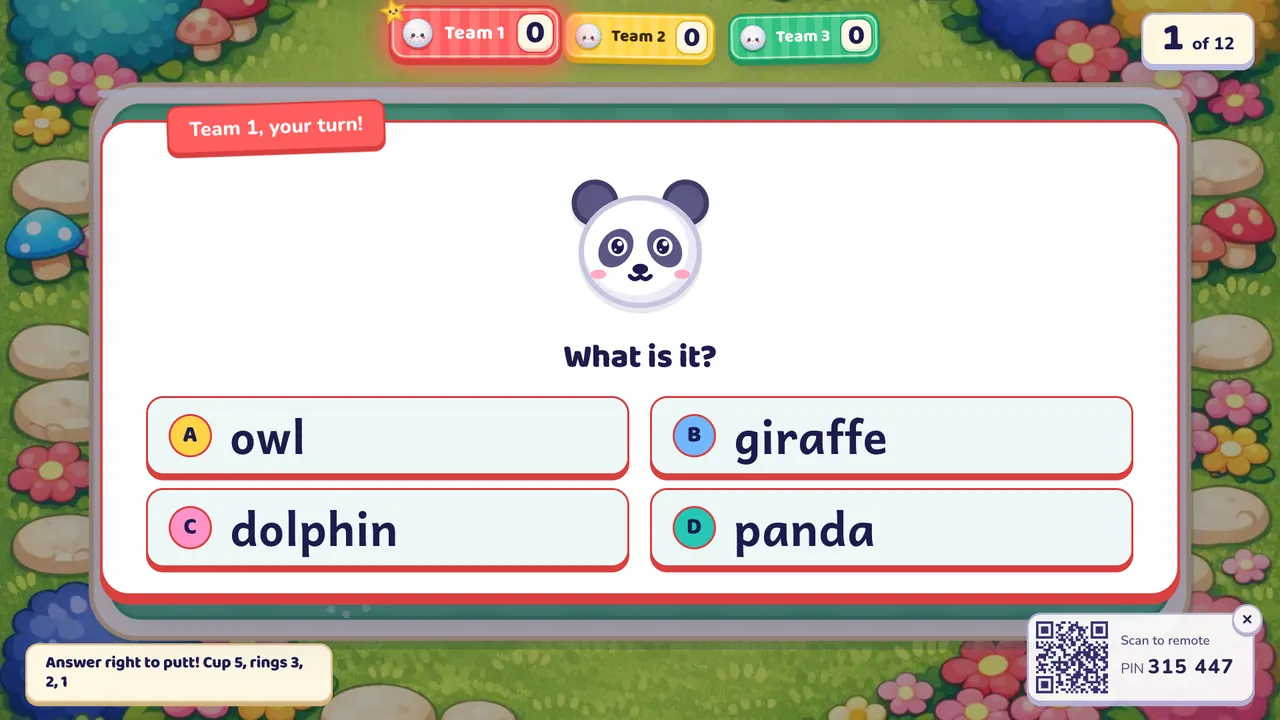
- Animals at A1: picture questions like the panda above.
- Prepositions of place: after each putt, "Where is the ball? It's next to the pond."
- Phrasal verbs at B1: meaning questions ("give up = ?").
Any subject works too: mental math, science true/false questions, or history dates as multiple choice.
Tips from the classroom
- Make the shot a decision. Ask the team to say why: "We need 5 to win, so we take the windmill."
- Teach risk with the table above: every shot averages the same, so when is a wild shot worth it?
- Big classes: four teams, a different student answering each turn. Add a class list and the screen shows whose turn it is.
- Turn on steal so a missed question isn't dead time for the other teams.
- When one team runs away with it, the windmill and the bumpers are the comeback shots.
- On a touch display, the student who answered can tap the choice.
Play it without a screen
- Draw a target on the board: a cup worth 5 in the middle, rings worth 3, 2 and 1 around it.
- Give five shot choices with a die each: Safe (1–2 is 1 point, 3–4 is 2, 5–6 is 3), Windmill (1–3 is 0, 4–6 is 5), and so on.
- After a right answer, the team picks a shot and rolls.
The screen version rolls the ball for real, keeps the odds and the score, and runs from your phone.
Questions teachers ask
Is Mini Golf free?
Yes. Every game is on the free plan with 2–4 teams, and library games and your own typed questions are free to play. The free plan also includes 10 AI question sets a month (3 from photos); Oly Pro adds more and up to 8 teams.
Do students need devices?
No. The class plays on one screen, and you run the game from your phone or the keyboard (C correct, X not yet, R show the answer, Space next).
How many students can play?
The whole class at once, in 2–4 teams on the free plan or up to 8 with Pro. Classes of 40 work fine.
Which shot is best?
On average they all score about the same. Safe never misses but never sinks it; the windmill and the bumpers sink it 3 times in 10 but often score nothing.
Can a team lose points?
Not from a putt: a miss is just 0. A team loses a point only if you switch on "Wrong answers lose a point", and a score never goes below zero.
Can I use my own questions?
Yes. Paste them as question | answer | wrong, wrong, or edit any set before you play.