Memory Match: a classroom memory game with word and picture cards
A classroom memory game for teams: answer right, flip two cards, and find a word and its picture for +2. Free, on one screen, no student devices or printing.
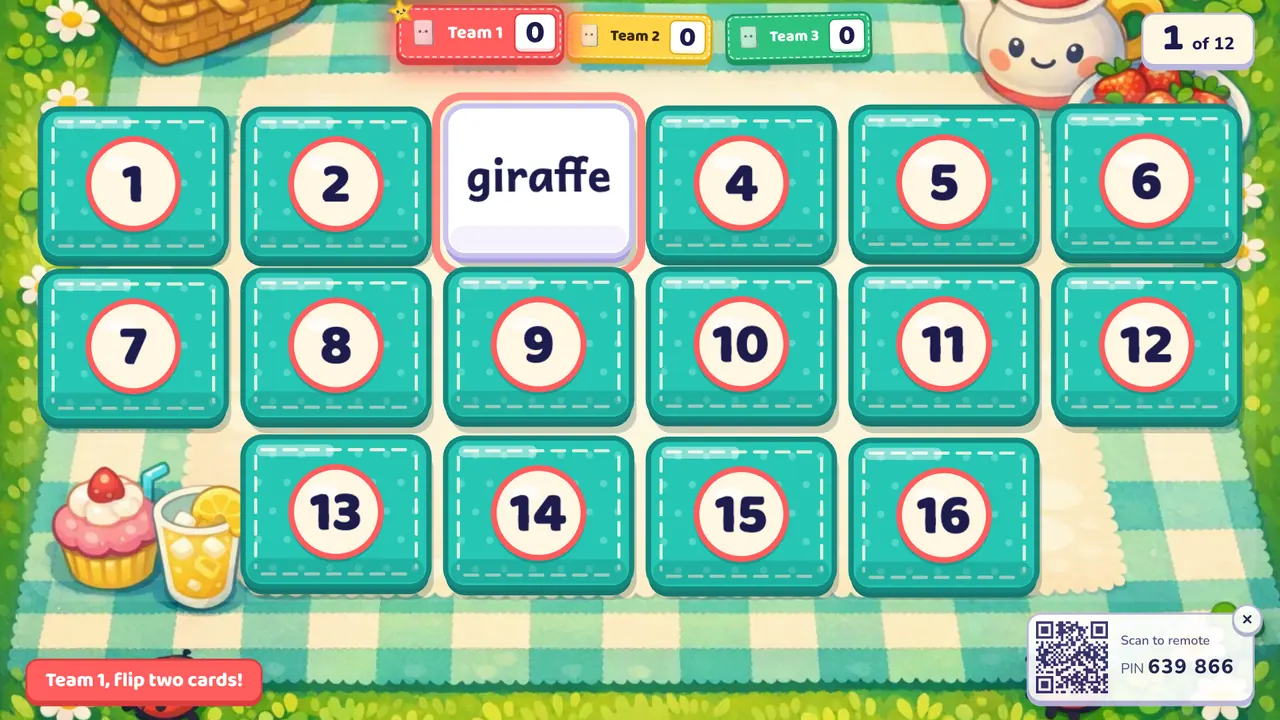
Memory Match is a classroom memory game for the whole class: teams answer questions, and every right answer lets them flip two cards to find a pair. In English, a pair is a word and its picture (or its translation), and Oly says the word aloud each time a pair is found. It suits young learners and beginners best, and works for other subjects with question and answer cards.
At a glance
| Players | 2–4 teams free (up to 8 with Oly Pro), the whole class |
| Time | 10–20 minutes for 10 to 16 questions |
| Works with | Every English question format and every subject (cards: word and picture, or question and answer) |
| Best for | New vocabulary, young learners, word and picture recall, touch screens |
| You need | One screen, your phone, and speakers so the class hears each word |
How to play Memory Match
- Make or pick a question set. Snap a textbook page, paste a word list, type a topic, paste your own questions, or open a set from the free library. Words with pictures make the best cards.
- Pick Memory Match, set the teams and start. With up to 10 questions the table has 12 cards (6 pairs); with more, 16 cards (8 pairs).
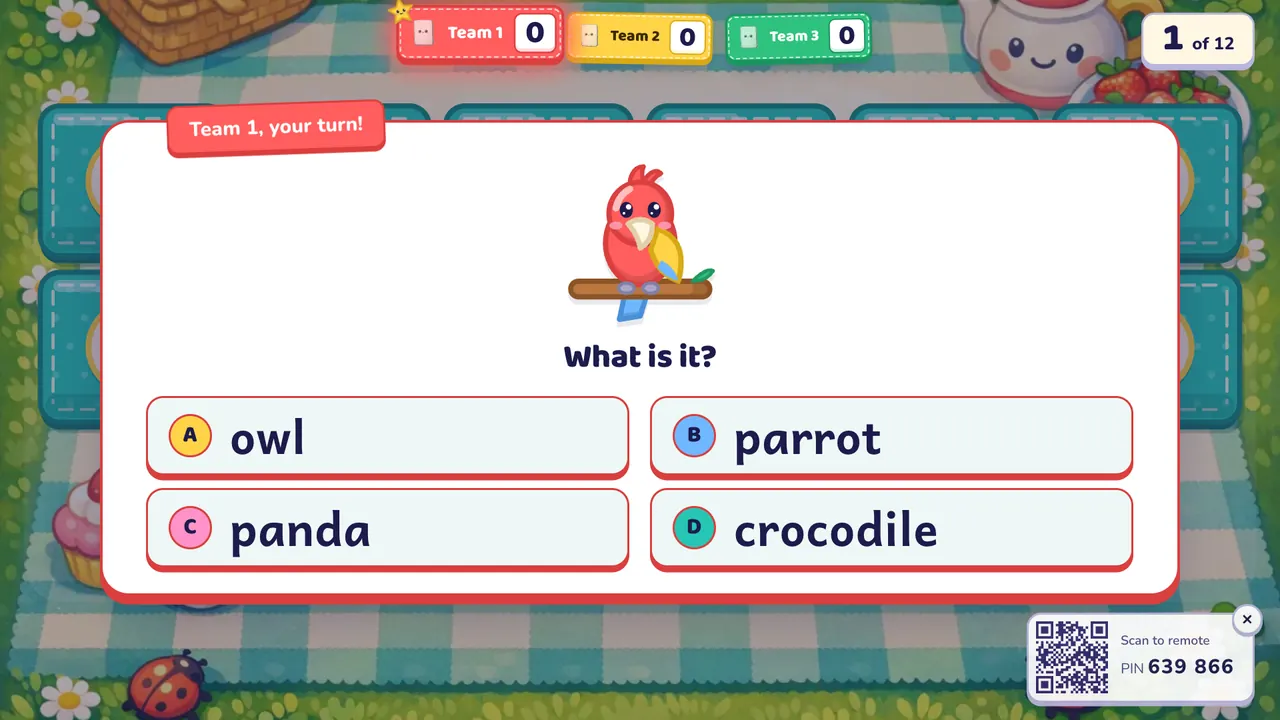
- Play. The team whose turn it is answers a question. If it's right, the team calls two card numbers, one after the other, and they turn over. A pair scores +2, Oly says the word, and the class repeats it. Not a pair? No points, and both cards show for a moment before they turn back, so every team should watch closely. A wrong answer flips nothing. The game ends when all pairs are found or the questions run out.
Rules and scoring
- A matching pair: +2 for the team that found it. The pair stays in that team's color.
- Two cards that don't match: no points; they show for a moment, then turn back over.
- Wrong answer: no flip. With "wrong answers lose a point" switched on, also −1 (scores never go below zero).
- Steal (off by default): when you turn it on, after a miss another team can answer; if it is right, that team flips the two cards.
- Double or triple questions: a pair found after that question is worth +4 or +6.
- Also: a timer per question (running out counts as wrong) and hiding the score for the whole game.
The cards come from your set. In an English set, a word with a picture becomes a word card and a picture card; a word without a picture pairs with its translation. In a subject set, a short question pairs with its answer (true/false questions aren't used as cards). If the set has too few pairs, Oly fills the table with words from its own picture vocabulary.
What you can teach with it
For English, the questions can be any type Oly makes: picture, find the picture, listen and choose, the missing letter, the word for a meaning, sentence order, or your own. The cards practise the link between a word and its meaning twice over. Some ideas:
- Fruit and vegetables at Pre-A1: picture questions, then the class says each word as the pair is found.
- Feelings or weather at A1: listening questions, so students hear the word before they look for it.
For other subjects, the cards pair a short question with its answer:
- Math: "7 × 8" with "56", or a fraction with its decimal.
- Geography: a country with its capital.
Tips from the classroom
- Make the whole team watch the flips. A card that didn't match is a gift to the next team that remembers it.
- Say the word together. When a pair is found, have the whole class repeat it after Oly; that's where the vocabulary sticks.
- Call one student per team. Type the class list on the start screen and Oly calls a different student each turn.
- On a touch display, students come up and tap their two cards.
- Keep words short. Long answers don't fit well on a card; one or two words work best.
Play it without a screen
- Write 12 or 16 numbers on cards, sticky notes or a grid on the board.
- On the back, or on your secret paper, put each word and its picture (a quick drawing is fine), mixed up.
- Ask a question; a team that answers right calls two numbers, and you show or draw what's there.
- A pair scores 2 and is crossed out; if they don't match, the class has to remember.
The screen version shuffles and deals the cards for you, says each word aloud, and keeps the score while you walk around with your phone.
Questions teachers ask
Is Memory Match free?
Yes. You can play it free with up to 4 teams, with library sets and your own typed questions. The free plan also makes 10 AI question sets a month; Oly Pro allows up to 8 teams and more AI sets.
Do students need devices?
No. The cards are on one shared screen. Only you use a phone, as the remote, and the keyboard works too.
How many cards are there?
12 cards (6 pairs) when you play up to 10 questions, and 16 cards (8 pairs) with more questions.
Does it work for subjects other than English?
Yes. In a math, science or history set, each card pair is a short question and its answer, and the questions are multiple choice, true/false or open.
What happens if the two cards don't match?
No points. Both cards show for a moment, then turn back over, so the teams that were watching can remember them for their own turn.
How many students can play?
Any number. The class splits into 2 to 4 teams on the free plan, up to 8 with Oly Pro.
For more games with a hidden board, try Mystery Picture or Team Bingo.