October 31, 2026
20 ESL warm-up games with no prep
20 quick ESL warm-up games that need nothing or almost nothing: word games, movement, speaking and listening starters, several playable on one screen.
The first five minutes of an English lesson decide the next forty. Students arrive from a break, another subject or a test, and their heads are somewhere else. A good warm-up brings them into English fast: everyone speaks or moves, nobody is left out, and it links to what you are about to teach.
Here are 20 warm-up games that need no preparation, or almost none. Most need only a board and your voice. The ones marked On one screen can also be played on a projector or TV with Oly, using your phone as the remote; they take a minute to set up with a ready set from the library or last lesson's words.
Quick guide
| Game | Level | Needs | Good for |
|---|---|---|---|
| Word chain | A1+ | Nothing | Vocabulary |
| Categories race | A1+ | Board | Vocabulary |
| Back to the board | A1+ | Board | Speaking |
| Twenty questions | A2+ | Nothing | Questions |
| Simon says | Pre-A1+ | Nothing | Listening, movement |
| What's missing? | Pre-A1+ | Pictures or objects | Memory |
| Mystery picture | Pre-A1+ | On one screen | Guessing |
| Listen and touch | Pre-A1+ | On one screen | Listening |
| Two truths and a lie | A2+ | Nothing | Speaking |
| Would you rather | A2+ | Nothing | Opinions |
Word games
1. Word chain
Say a word. The next student says a word that starts with the last letter: cat, tiger, rabbit, table… Go round the room or bounce between teams. A pause of more than five seconds and the chain restarts. For a topic version, every word must be food, or animals, or verbs.
2. Categories race
Draw columns on the board: animal, food, colour, place. Call a letter. Teams have one minute to write a word for each column starting with that letter. One point for each word no other team has.
3. Alphabet race
Two students at the board, a topic called out ("clothes!"). They race to write a word for as many letters of the alphabet as they can in one minute. Their teams can whisper help but not shout.
4. Spell it round
Pick a word from last lesson. Students spell it one letter each, round the room. The student who says the last letter says the whole word, and the next student starts a new word.
5. Letter ring
On one screen. Letter Ring puts the alphabet in a ring, with a clue for each letter. The team says the word that starts with it, takes the letter, or passes, and passed letters come back on the next lap. A good way to bring back a whole unit's vocabulary (English sets only).
6. Missing letters
Write five words from last lesson with letters missing: el_ph_nt, b_n_na. Students call out the full words. Ten seconds of prep, and it reviews spelling without a test.
Speaking warm-ups
7. Back to the board
One student sits with their back to the board. You write a word behind them; their team describes it without saying it. They guess, swap, and the next team plays.
On one screen: Hot Seat runs this for you with 60-second rounds, a card with the word and a picture, and Got it and Pass buttons on your phone. Oly never says the word aloud.
8. Two truths and a lie
A student says three sentences about themselves; two are true. The class asks one question each, then votes on the lie. Model it first with your own three sentences. Great practice for the past simple: "Last summer I…"
9. Would you rather
"Would you rather be a fish or a bird?" Students answer with a reason: "I'd rather be a bird because…" Point to one side of the room for each option, and students move there before they explain.
10. Twenty questions
Think of an animal, an object or a famous place. The class may ask up to twenty yes/no questions. Count them on the board. A good warm-up for question forms: "Is it…? Does it…? Can it…?"
11. Picture dice story
Draw three quick pictures on the board (a dog, a bus, a cake), and teams make one sentence using all three.
On one screen: Picture Dice rolls three picture dice from your set after each right answer, and you tap how many pictures the team used in its sentence (English sets only).
12. Finish my sentence
Start a sentence: "On Saturday I…", "My favourite food is… because…". Students finish it in pairs, then two or three share. Change the opener to the grammar of the day.
Listening and movement
13. Simon says
The classic, still the best for young learners. "Simon says touch your nose." Use the body, classroom objects and actions from your unit. For older students, speed it up and use phrasal verbs: "Simon says stand up, sit down, turn around."
14. Listen and touch
Put pictures or flashcards on the board. Say a word; one student from each team races to touch it.
On one screen: Listen and Touch does this with Oly's voice: Oly says the word, students race to touch the picture on the screen, and you tap the team that got there first. On a touch screen, Pop the Word is the whack-a-mole version.
15. Stand up if…
"Stand up if you have a brother. Stand up if you ate rice yesterday." Students listen for the meaning and move. Then a student takes your place and gives the instructions.
16. Running dictation, lite
Write a short sentence on paper at the back of the room. One student per team runs to read it, comes back and whispers it to a writer. First team with the correct sentence wins. Two minutes, lots of energy.
Memory and review
17. What's missing?
Show six pictures or objects. Students close their eyes; you take one away. "What's missing?" The first team to name it gets a point. Do it on the board with drawings if you have no cards.
18. Mystery picture
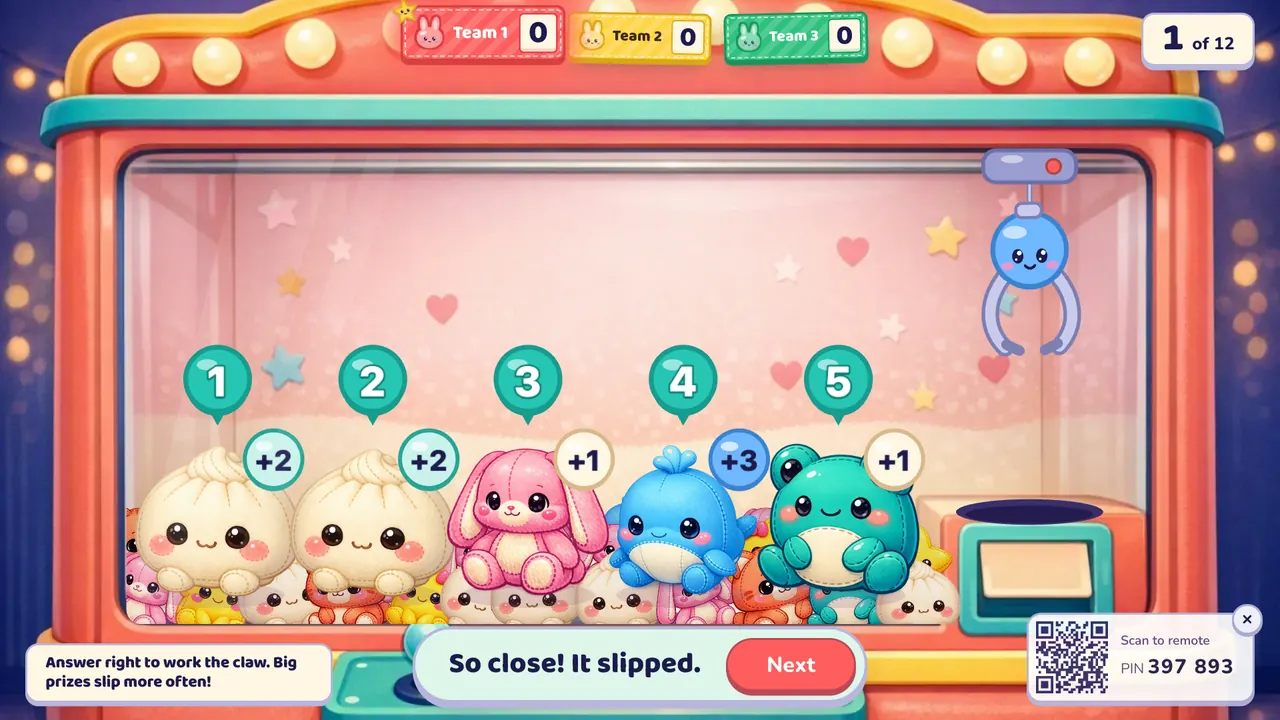
On one screen. In Mystery Picture, each right answer removes a numbered piece of a hidden picture, and the first team to name the picture wins a bonus. A strong opener for a new topic: the hidden picture becomes the lesson's theme.
19. Missed words from last lesson
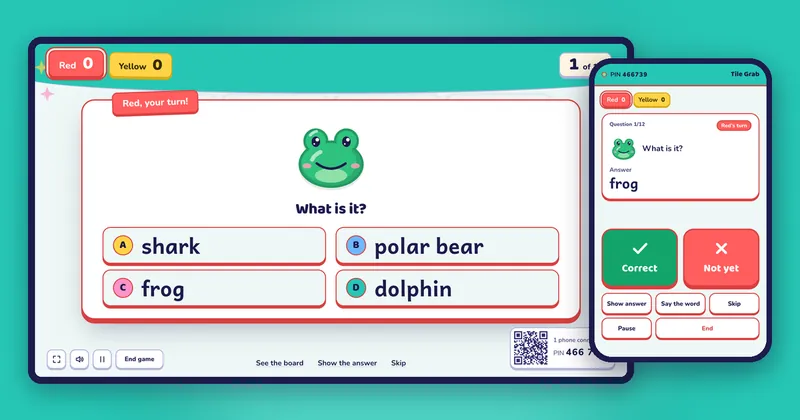
On one screen. At the end of every Oly game, the summary lists the words the class missed, and Review missed words makes a new game from just those. Play it as the next lesson's warm-up, in a quick game like Tile Grab. The Ready page also reminds you what the class missed last time when you open the same set.
20. Team bingo
Students draw a 3×3 grid and fill it with words from last lesson. You read definitions; they cross out the word. First line wins.
On one screen: Team Bingo builds a card for each team from the set, and each question stamps every card that has the answer, so every team listens to every question.
Making warm-ups work
- Keep it short. Five minutes, then stop while it's still fun. A warm-up that drags becomes the lesson.
- Link it to the lesson. Use the words or the grammar you are about to teach, or the ones the class missed last time.
- Everyone does something. Choose games where every student speaks, writes or moves, not just one volunteer.
- Same routine, new game. Students learn the habit ("first five minutes, we play"), and you change the game each week.
- No prep means no prep. If a warm-up needs printing and cutting, it's an activity, not a warm-up.
Warm-ups on one screen, in a minute
For the warm-ups marked On one screen, open a set from the library or make one from today's page, pick the game, and scan the QR code with your phone. Students need no devices, and the same set plays in every game, so Monday's Mystery Picture can be Friday's Team Bingo. More ideas: 10 English vocabulary games for one screen and classroom games without student devices.
Try these games
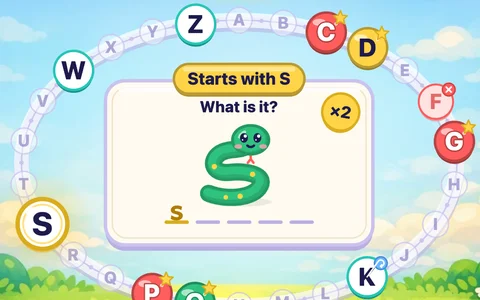 Letter RingGo round the alphabet: say the word for each letter. Pass and it comes back next lap.
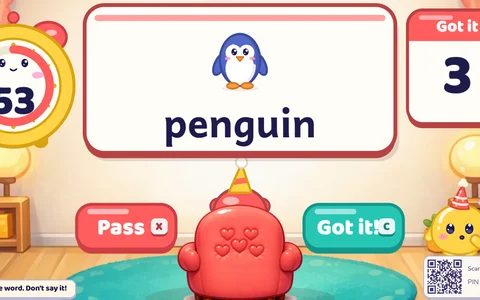 Hot SeatOne player sits with their back to the screen; the team describes words to them against the clock.
 Picture DiceAnswer right to roll three picture dice, then make a sentence or a story with them. A speaking game.