Dare Board: pick your points, then answer the question
A points board review game: teams pick a tile worth 1 to 5 before the question, and the higher the tile, the harder the question. Free, one screen, no devices.
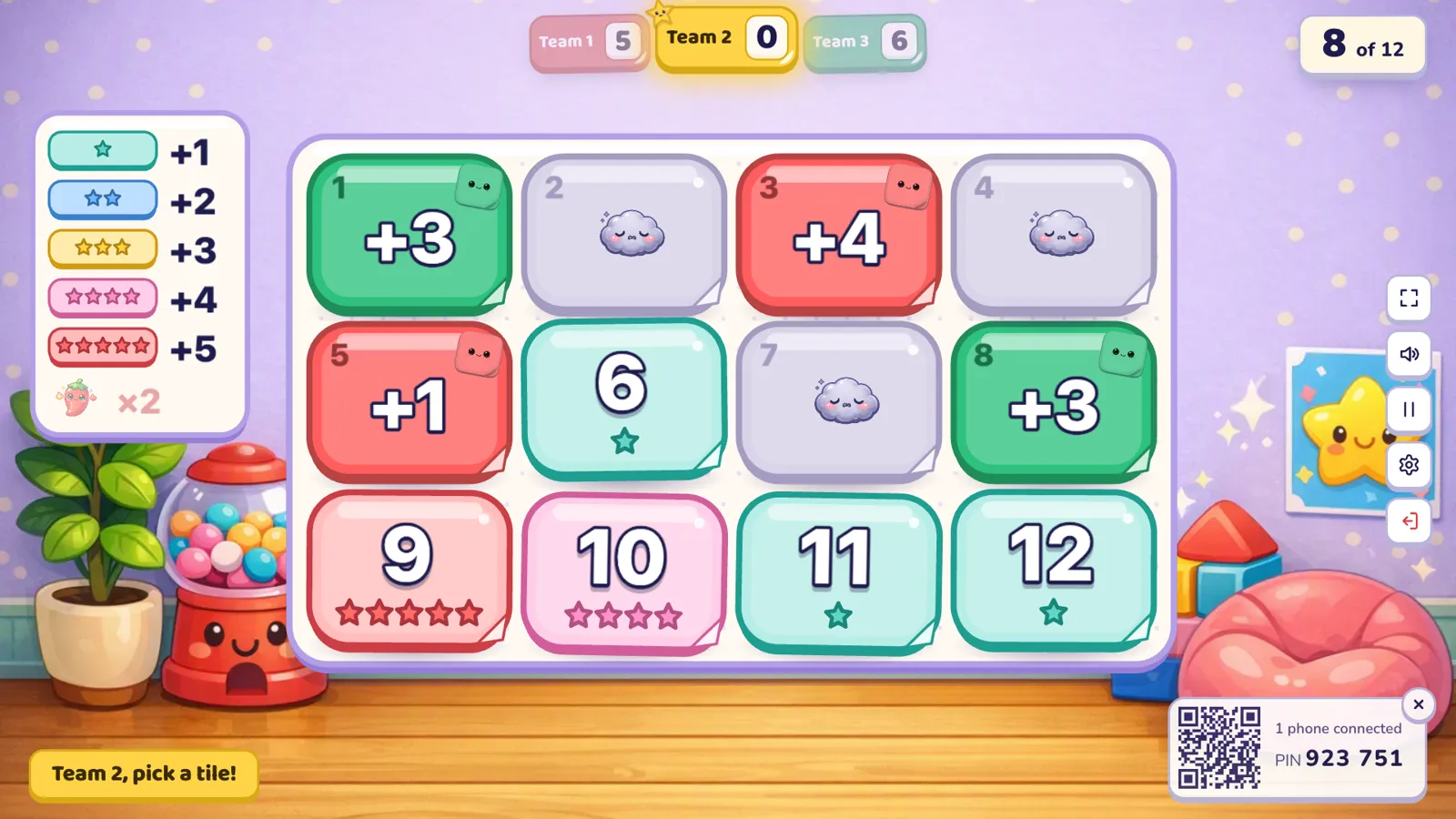
Dare Board is a points board review game where teams choose their risk before they see the question. The board is a grid of numbered tiles worth 1 to 5 stars. The team picks a tile, and the tile brings a question to match: a 1 is an easy one, a 5 is the hardest in your set. Answer right and the tile is yours; miss and it's gone. One tile hides a Double dare worth twice its points.
At a glance
| Players | The whole class in 2–4 teams free (up to 8 with Oly Pro) |
| Time | About 10–20 minutes for 12 to 25 questions |
| Works with | Every English question format and every subject (multiple choice, true/false, open questions) |
| Best for | Mixed-level classes, test review, teaching teams to judge what they know |
| You need | One screen (projector, TV or interactive display) and your phone as the remote |
How to play Dare Board
- Make or pick a question set. Snap a textbook page, paste a word list, type a topic or your own questions, or start from the free library. A set with a mix of easy and hard questions makes the best board.
- Pick Dare Board, set the teams and start. The board has one tile per question, up to 25 tiles.
- Play. On its turn, a team picks a tile by its number (tap it on the screen or on your phone). The tile pops forward, and a moment later its question opens. A right answer wins the tile in the team's colour and its points. A wrong answer burns the tile, and it falls asleep under a grey cloud. When every tile is won or burnt, the team with the most points wins.
Rules and scoring
- Tile values: 1 to 5 stars, spread across the board. With fewer than 15 tiles there are a few more low tiles than high ones.
- The question fits the tile. Before the game, Oly ranks your questions from easiest to hardest, and each tile brings an unasked question whose difficulty matches its value. Picture and true/false questions count as the easiest; spelling, sentence order and open questions as the hardest; double and triple questions and long answers make a question harder.
- Double dare: one random tile hides a chilli pepper. It flips over when picked, and a right answer scores twice its points. You can switch the Double dare off in the power-ups.
- Wrong answer: the tile burns and nobody gets it. With steal on (off by default), the other teams can still answer, and a team that gets it right wins the tile.
- Skipped question: its tile burns too.
- Double and triple questions multiply the tile's points.
- Also: a timer per question (10 to 60 seconds; running out counts as a wrong answer), wrong answers losing a point (off by default; scores never go below zero), hidden scores, seasonal looks and calm or no effects.
What you can teach with it
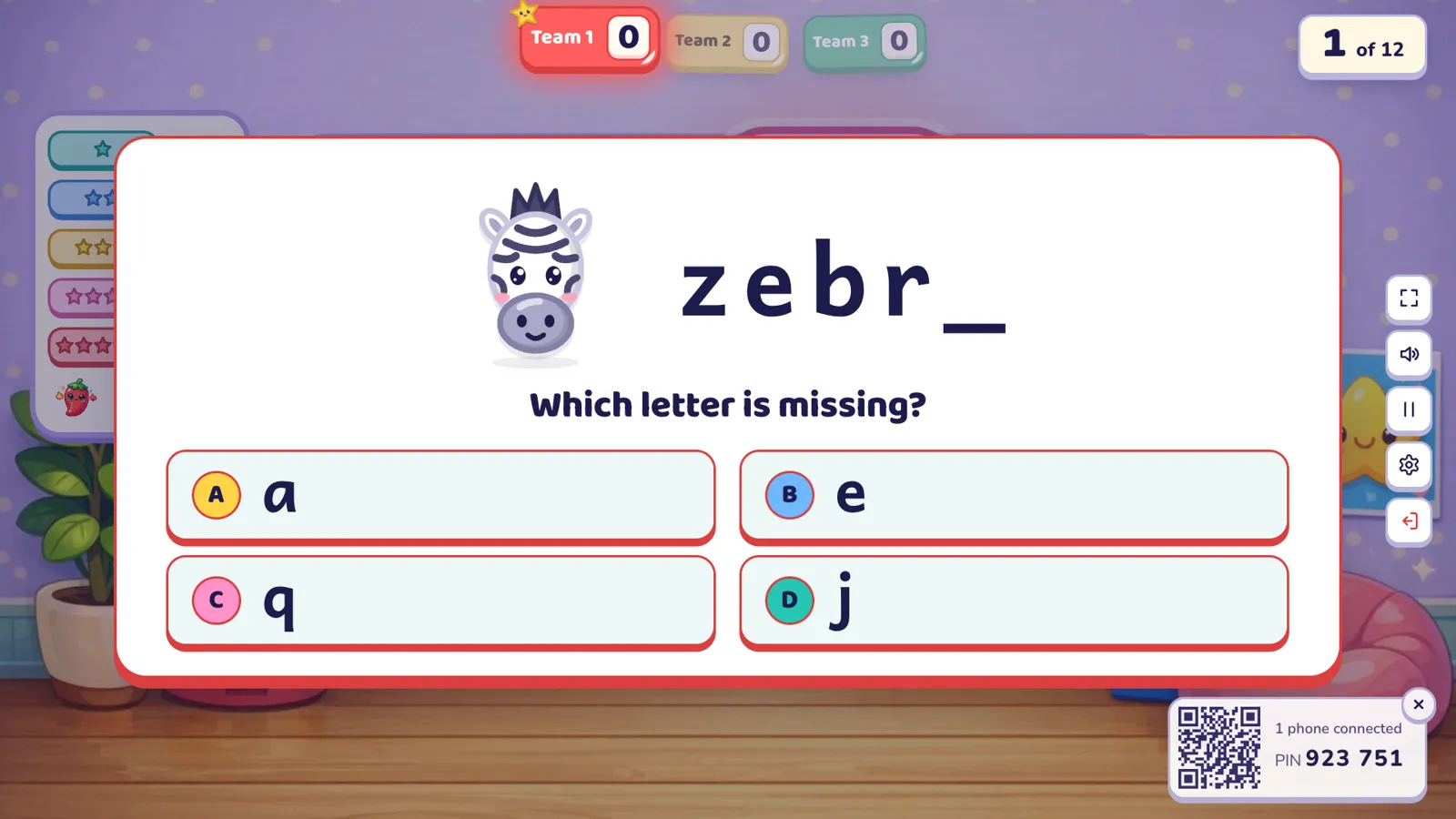
For English, Dare Board mixes the question formats into easy and hard on its own: picture questions turn up on low tiles, spelling and sentence order on high ones.
- A1 vocabulary: a set of animals or food. Low tiles are "What is it?", high tiles ask to spell the word.
- A2 grammar: add your own questions for the hard tiles ("Put the words in order: never / she / late / is").
- B1 vocabulary: meanings and open questions, with long answers on the 5s.
For other subjects, true/false questions land on low tiles and open questions on high ones:
- Math: easy true/false sums for 1s, word problems for 5s.
- Science: "Plants need light: true or false?" on a 1, "Name the gas plants give out" on a 5.
Tips from the classroom
- Make the team say why. "We'll take a 4, because we know this topic." Picking is a quick check of what the class thinks it knows.
- Mixed-level classes: weaker teams can win steady points with 1s and 2s while strong teams go for 5s, and everyone has a fair game.
- Mark some questions double in the editor for an end-of-test review: they rank as harder and land on the big tiles.
- Turn on steal so a burnt tile can still be won by a team that was listening.
- Big classes: with a class list, Oly names one student per team each turn, and that student picks the tile.
Play it without a screen
- Draw a grid of numbered squares on the board and write a value from 1 to 5 in the corner of each.
- Sort your questions into five piles, easy to hard, before the lesson.
- A team picks a square; read a question from the matching pile.
- Right: write the team's initial in the square and add the points. Wrong: cross it out. Pick one square in secret for a double.
The screen version ranks the questions for you, hides the Double dare and keeps the score.
Questions teachers ask
Is Dare Board free?
Yes. You can play it free with up to 4 teams, with library sets and your own typed questions. The free plan also makes 10 AI question sets a month (3 from photos); Oly Pro allows up to 8 teams and more AI sets.
Do students need devices?
No. The whole class plays on one screen. Only you use a phone, as the remote; the keyboard works too.
How does Oly know which questions are hard?
It looks at the question type (a picture question is easier than spelling or an open question), whether you marked it double or triple, and how long the answer is. A 5-star tile gets one of the hardest questions left.
Can a team lose points?
Only if you switch on "Wrong answers lose a point". A missed tile just burns: nobody scores it.
Can I use my own questions?
Yes. Paste them as question | answer | wrong, wrong, type them in the editor, or edit any set before you play.
For more choosing and risk, try Prize Climb or Tile Grab.