Balancing Chemical Equations Simulation
A free balancing equations simulation for class: change the coefficients, watch the molecules appear, count atoms on both sides and see the balance level out.
Free, no sign-up, runs in the browser on a projector, TV or touch screen.
Make a review gameFree games library
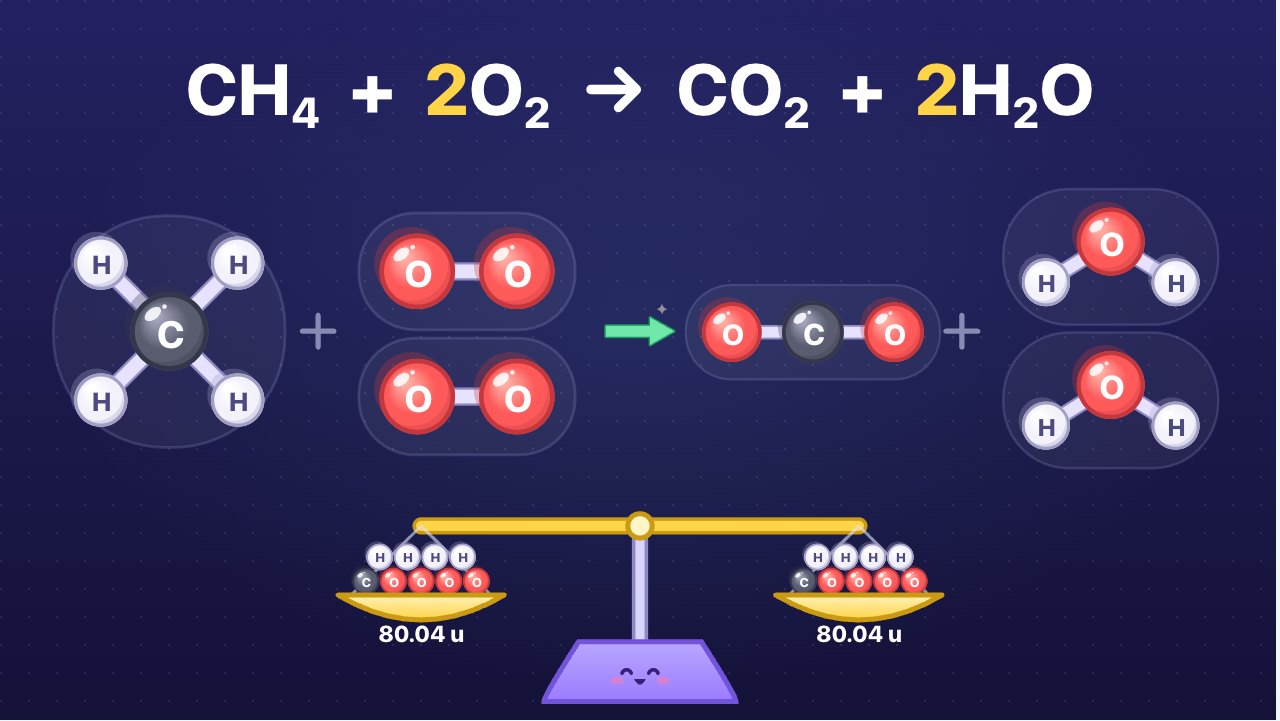
This simulation puts a chemical equation in front of the whole class and lets you balance it the way chemists do: by changing the big numbers in front of each formula. Every time a coefficient goes up, one more molecule pops up under that formula, drawn as balls and sticks, so students can see that "2H₂O" really means two water molecules. A table counts the atoms of each element on both sides and turns green when they match, and a balance holds every atom of the reactants in one pan and every atom of the products in the other. When all elements match with the smallest whole numbers, the balance levels out, the arrow turns green and the confetti flies.
How to use it
- Change the coefficients: tap + or − above and below each number. With a keyboard, Tab to a number and use the up and down arrows (or type a digit); left and right arrows move to the next substance.
- Watch the molecules: under each formula there is one cluster per molecule. Hydrogen is white, carbon dark grey, oxygen red, nitrogen blue, chlorine green, sodium purple, iron orange, sulfur yellow, and every ball carries its symbol.
- Count the atoms: the table has a column per element, reactants above and products below. Matching numbers turn green, the others stay red.
- Read the balance: each pan holds all the atoms of its side, and their mass in atomic mass units (u). The heavier side goes down. When the atoms balance, the masses are equal: the law of conservation of mass.
- Hint: the Hint button names the element to fix first and circles its atoms in yellow. If everything matches but all numbers share a factor, it tells you what to divide by.
- Levels: Easy (water, salt, magnesium oxide…), Medium (methane, rust, ammonia, limestone in acid…) and Hard (propane, aluminium oxide, the blast furnace, glucose…), 22 equations in all. The arrows next to the equation go to the next one.
- Type your own: type any equation, for example
Ca(OH)2 + HCl -> CaCl2 + H2O. Brackets and hydrates such asCuSO4·5H2Owork; use->or=for the arrow. Oly checks that every element is on both sides and that the equation can be balanced. - Teams: choose 2, 3 or 4 teams. The atom counts and masses are hidden, so the team at the board has to count from the molecules. Press Check: a right answer scores 1, 2 or 3 points by level (one less after a hint), a wrong one passes the equation to the next team.
- Projector: the full screen button in the top right makes everything bigger for the back row. On a touch screen students can tap the + and − buttons themselves.
What a balanced equation means
In a chemical reaction atoms are not made or destroyed, only rearranged into new substances. The equation must show the same number of atoms of every element on both sides of the arrow.
- Reactants are the substances on the left, the ones that react. Products are on the right, the ones that are made.
- Coefficients are the big numbers in front of a formula: how many molecules (or formula units). They are what you change to balance an equation.
- Subscripts are the small numbers inside a formula: how many atoms in one molecule. Changing them changes the substance (H₂O is water, H₂O₂ is hydrogen peroxide), so they are never changed when balancing.
Atoms of an element on one side = coefficient × subscript, added over every substance on that side. For CH₄ + 2O₂ → CO₂ + 2H₂O, oxygen on the left is 2 × 2 = 4 and on the right 1 × 2 + 2 × 1 = 4.
Conservation of mass
Because the same atoms are on both sides, the total mass is the same before and after the reaction. That is the law of conservation of mass (Lomonosov and Lavoisier). The balance in the simulation adds up the atomic masses: 2H₂ + O₂ → 2H₂O has 36.03 u on each side, since 2 × 2.016 + 31.998 = 2 × 18.015. While the equation is not balanced, one pan is heavier, which would mean atoms appeared from nowhere or vanished.
The smallest whole numbers
4H₂ + 2O₂ → 4H₂O has the same atoms on both sides, but every number can be divided by 2. A balanced equation is written with the smallest whole numbers, so the simulation says "Balanced, but not the smallest numbers" until you divide.
A method that works: balance by inspection
- Count the atoms of each element on both sides (the table does this for you).
- Start with an element that appears in only one substance on each side, usually a metal or carbon. Leave hydrogen and oxygen for last, because they are often in several substances.
- Change one coefficient to fix that element, then count again: fixing one element can unbalance another.
- Finish with hydrogen, then oxygen. If you end up with a fraction, such as 3½ O₂ for ethane, double every number.
- Check that every element matches and that the numbers cannot all be divided by the same number.
Try it on propane: C₃H₈ + O₂ → CO₂ + H₂O. Carbon first: 3CO₂. Then hydrogen: 4H₂O. Now oxygen on the right is 3 × 2 + 4 = 10, so 5O₂. Answer: C₃H₈ + 5O₂ → 3CO₂ + 4H₂O.
Teaching ideas
The simulation fits the chemical reactions unit of middle school science and introductory chemistry: writing and balancing equations, reactants and products, and the conservation of mass. In the NGSS it supports MS-PS1-5 (a model showing that atoms are conserved in a reaction, so mass is conserved) and HS-PS1-7 (using mathematical representations to show that atoms and mass are conserved); in GCSE Chemistry it supports conservation of mass and balanced symbol equations.
- Warm-up (3 minutes): show H₂ + O₂ → H₂O with all ones. Ask: "Count the oxygen atoms on each side. Where did one go?"
- Coefficient or subscript (5 minutes): ask a student to fix the oxygen. Someone will suggest H₂O₂: write it on the board and ask what that substance is. Then add a water molecule with + and count again.
- Mass (5 minutes): watch the balance while the class balances water. Ask: "Why are the masses equal now? What does that tell us about atoms?"
- The method (10 minutes): balance methane and propane together, using the hint only when the class is stuck. Ask students to say the method in their own words.
- Teams (10 minutes): switch to Teams and pick a level. Teams take turns at the board; the rest of the class counts along before the team presses Check.
- Review: make a review game: the whole class plays on the same screen in teams, with your phone as the remote.
Questions teachers ask
Why can't students change the small numbers?
The small numbers (subscripts) tell you what the substance is. Changing H₂O to H₂O₂ turns water into hydrogen peroxide, a different substance, so the equation would describe a different reaction. Only the coefficients can change, and the simulation shows them as the number of molecules.
What does "balanced, but not the smallest numbers" mean?
Every element matches, but all the coefficients share a factor, like 4H₂ + 2O₂ → 4H₂O. The reaction is right, but equations are written with the smallest whole numbers, so divide them all by the common factor (here 2H₂ + O₂ → 2H₂O).
Are the masses on the balance real?
Yes. Each atom counts with its standard atomic weight from IUPAC (H 1.008, C 12.011, O 15.999 and so on), and the pan shows the total in atomic mass units. When the atoms balance the two totals are equal, which is the law of conservation of mass.
Which equations can I type?
Any equation with formulas made of element symbols, numbers and brackets, such as Al + CuSO4 -> Al2(SO4)3 + Cu or CuSO4·5H2O -> CuSO4 + H2O. Use + between substances and -> or = for the arrow. Ions with charges are not supported. If an element is only on one side, a formula is mistyped (capital letters matter: Co is cobalt, CO is carbon monoxide) or the equation can be balanced in more than one way, Oly says so. Coefficients up to 16 are allowed.
Are the molecule pictures the real shapes?
They are flat ball-and-stick pictures drawn to count atoms, with fair shapes for small molecules: water is bent, carbon dioxide is straight, methane has four hydrogens around the carbon. Real molecules are 3D. Ionic compounds such as sodium chloride or aluminium oxide are not made of molecules at all; the picture shows one formula unit (one NaCl, one Al₂O₃).
Does it work on an interactive whiteboard?
Yes. The + and − buttons are big enough to tap, the equation and the counts are large enough for the back row, and full screen makes them bigger. It works on a phone too. Nothing to install and no sign-up: it runs in the browser and it's free.