Food Chains and Food Webs Simulation
A free food web simulation for class: draw who eats whom in a meadow, pond or forest, see producers and consumers, then remove a species and watch the web change.
Free, no sign-up, runs in the browser on a projector, TV or touch screen.
Make a review gameFree games library
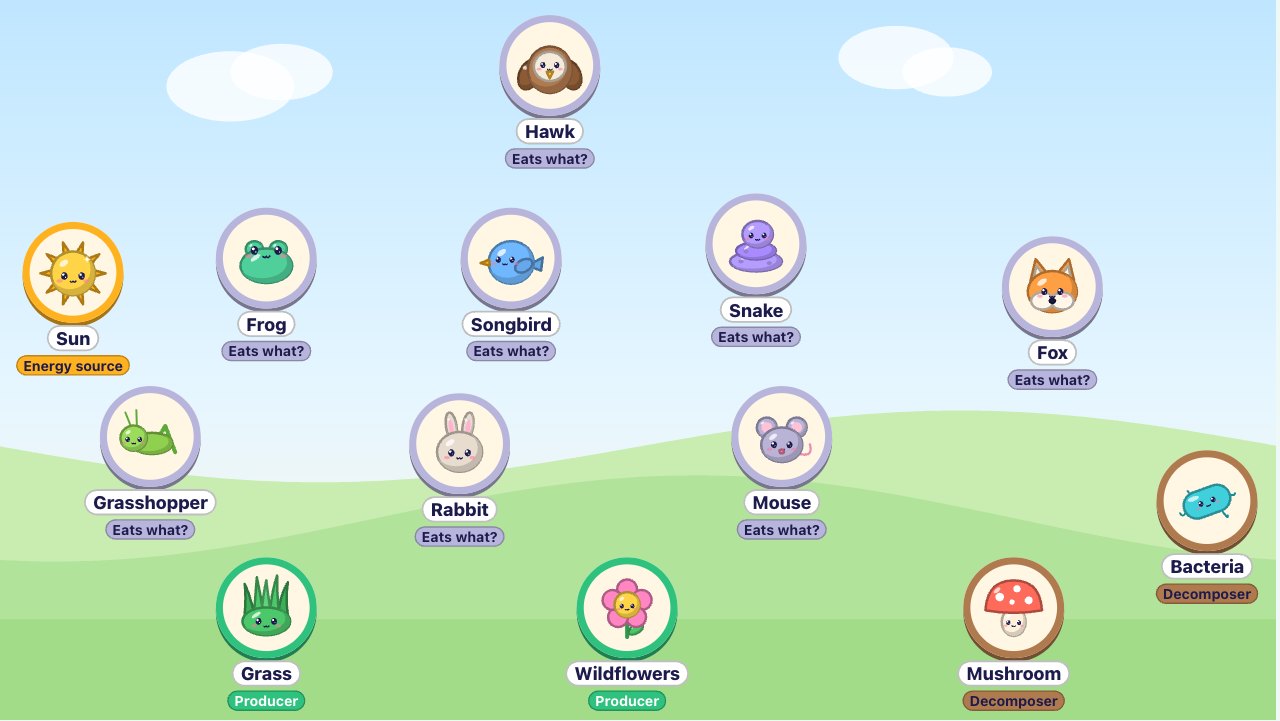
This is a food web the whole class builds together on a projector, TV or interactive whiteboard. Pick a meadow, a pond or a forest, then drag from a living thing to the one that eats it: an arrow appears, pointing the way the energy goes. Put an arrow the wrong way round, like a rabbit eating a fox, and it springs back with a short hint. As the arrows go in, every organism gets its role (producer, primary, secondary or tertiary consumer, decomposer) and the longest food chain lights up. Then switch to Balance, press Play, and make one species disappear: the class watches the effect ripple through the whole web.
How to use it
- Pick a habitat: Meadow, Pond or Forest at the top. Each has the Sun, two producers, eight or nine animals and one or two decomposers. Each habitat keeps its own arrows.
- Draw an arrow: press on an organism and drag to the organism that eats it. Release, and the arrow stays if it is right. A wrong arrow bounces back and the hint says why: backwards, plants don't eat, nothing eats the Sun, or "not in this habitat". Several fingers can draw at once on a touch board.
- The Sun and decomposers: drag from the Sun to a plant (light gives the plant energy), and from any plant or animal to a mushroom or bacteria (they break down its dead remains). Decay arrows are dashed and paler, so the food web stays easy to read.
- Remove an arrow: tap it. Undo brings back the last change; the bin clears all the arrows.
- Show the whole web: fills in every right arrow, for a quick start or to check the class's web.
- Tap an organism: the panel tells you what it is, what it eats and what eats it, from the arrows on the board. Its other arrows fade so you can follow its links.
- Balance: press 2 · Balance, then Play. Tap an organism and press Disappears; press Comes back to return it. The bars under each organism and the chart show every population as a share of the start.
- Keyboard and projector: the full screen button in the top right makes everything bigger. Arrow keys pick an organism, Enter starts an arrow and Enter again ends it on the eater, Delete undoes, Space plays and pauses in Balance.
Food chains: who eats whom
A food chain shows how energy passes from one living thing to the next when one eats another. The arrow means "is eaten by", so it always points from the food to the eater:
grass → grasshopper → frog → snake → hawk
Every food chain starts with a producer: a green plant (or alga) that makes its own food from sunlight, water and carbon dioxide by photosynthesis. Animals cannot do that, so they are consumers: they get their energy by eating.
- A primary consumer eats producers (the grasshopper, the rabbit). Animals that eat only plants are herbivores.
- A secondary consumer eats primary consumers (the frog eats grasshoppers).
- A tertiary consumer eats secondary consumers (the snake eats frogs), and so on up to the top predator, which nothing in the habitat hunts (the hawk, the heron, the owl).
- Decomposers (fungi such as mushrooms, and bacteria) break down dead plants, dead animals and waste. They return the nutrients to the soil or the water, where plants take them up again.
Each organism in a chain is a link, and each step is a trophic level. The simulation counts the links: grass → grasshopper → frog → snake → hawk has five links joined by four arrows. In the full webs, the longest chains have five links in the meadow and the pond, and four in the forest.
Food webs: chains that cross
Real animals eat more than one thing, so the chains of a habitat cross and join into a food web. In the meadow, the mouse eats seeds and grass (a primary consumer) and grasshoppers too (a secondary consumer): an omnivore can sit at more than one level. The simulation shows this with a ring split into two colours and a label such as "1st + 2nd consumer". The hawk eats snakes, mice, rabbits and songbirds, so it is a 2nd, 3rd and 4th consumer at once.
| Habitat | Producers | Primary consumers | Higher consumers | Decomposers |
|---|---|---|---|---|
| Meadow | grass, wildflowers | grasshopper, rabbit, mouse, songbird | frog, snake, fox, hawk | mushroom, bacteria |
| Pond | algae, duckweed | water flea, tadpole, snail, minnow, duck, turtle | catfish, heron | bacteria |
| Forest | oak tree, berry bush | caterpillar, deer, squirrel, mouse, robin, bear | wolf, owl | mushroom, bacteria |
Why are top predators few? At each step most of the energy is used for living (moving, keeping warm) or lost as heat, and only about a tenth passes on to the next level. That is why food chains rarely have more than four or five links, and why a habitat has far more grass than hawks.
Balance: what happens when a species disappears
In Balance, the web the class drew runs as a population model. Each step, every population changes by its births minus its deaths:
- plants grow until they fill their space (logistic growth: rN(1 − N/K), K being the carrying capacity);
- each animal eats its foods at a rate that levels off when food is plentiful, turns part of what it eats into young, and loses some to death and crowding;
- everything an animal eats is taken away from its food's population;
- decomposers live on what dies and keep the soil fertile: without them, the plants' carrying capacity drops.
This is the Lotka–Volterra predator-prey idea, with the limits that keep real ecosystems steady. Start, and every population stays at 100%: the web is in balance. Then remove something:
- A producer. Remove the algae in the pond: the water fleas and tadpoles, which eat nothing else, die out. The minnows lose their food and follow, and then the heron, which hunts them, goes hungry too. Remove the grass in the meadow: the grasshoppers, rabbits and mice drop, then the animals that eat them.
- A predator. Remove the fox: rabbits and mice increase, then eat more grass. Sometimes the effects surprise: in the forest, removing the berry bush starves the robins, and with fewer robins eating them the caterpillars increase.
- The decomposers. Remove the bacteria in the pond: nothing returns the nutrients, the algae and duckweed slowly shrink, and the whole web follows.
The numbers are relative (100% is the population at the start), not real counts of animals. The model shows the direction and the ripples, which is what the lesson needs.
Teaching ideas
The simulation fits the life science units on ecosystems: NGSS 5-LS2-1 (the movement of matter among plants, animals, decomposers and the environment) and MS-LS2-3 (cycling of matter and flow of energy among living and nonliving parts of an ecosystem), and the food chains topic of primary science and KS3 biology.
- Warm-up (3 minutes): open the meadow with no arrows. Ask: "What does the rabbit eat? Who would eat the rabbit?" Invite a student to draw grass → rabbit → fox.
- The wrong way round (3 minutes): ask a student to draw an arrow from the fox to the rabbit. It bounces back. Ask: "Why does the arrow point to the fox, not to the rabbit?" (It shows where the energy goes.)
- Build in teams (10 minutes): two students at the board, each drawing chains with a finger, while the class calls out the next link. Who can make the longest chain? The status panel shows it.
- Classify (5 minutes): point at the frog, the mouse and the hawk. "Producer or consumer? Which level?" Tap to check, and talk about why the mouse has two colours.
- Predict, then remove (10 minutes): switch to Balance and press Play. Before tapping Disappears on the grass, ask: "Which animals will go down first? Will any go up?" Then watch the bars and the chart. Try the fox, then the bacteria.
- Review (10 minutes): make a review game: the whole class plays on the same screen in teams, with your phone as the remote.
Questions teachers ask
Which way should the arrows in a food chain point?
From the food to the eater: grass → rabbit means "the grass is eaten by the rabbit". The arrow shows the direction the energy flows. Students often draw it the other way ("the rabbit eats the grass"), which is why the simulation bounces those arrows back with a hint.
What is the difference between a food chain and a food web?
A food chain is one path of eating, from a producer to a top consumer. A food web is all the food chains of a habitat joined together, because most animals eat several foods and are eaten by several others. A web is more stable than a single chain: if one food runs short, the eaters can switch to another.
Is the Sun part of the food chain?
The Sun is not a living thing, so it is not counted as a link, but it is the source of the energy: plants capture sunlight to make food. The simulation lets students draw arrows from the Sun to the plants and calls the Sun the energy source. The longest chain is counted from the producer.
Where do decomposers go in a food web?
Decomposers (fungi and bacteria) feed on the dead remains and waste of every other level, so arrows go to them from producers and consumers alike. They return nutrients to the soil or water for the plants. In Balance, removing them makes the plants slowly decline.
Are the population numbers real?
They come from a real kind of model (Lotka–Volterra with logistic plant growth, saturating feeding and crowding), but the habitats and the rates are simplified for class, so the numbers are relative: 100% is the start. What matters is the direction of each change and how it spreads through the web.
Do I need to install anything, and does it work on a touch board?
No installing and no sign-up: it runs in the browser and it's free. On an interactive whiteboard every finger draws its own arrow, so two students can build at the same time. On a phone the panel sits below the web.