Friction and Inclined Plane Simulation
A free friction simulation for class: tilt a ramp, pick ice, wood or rubber, push a box and see static and kinetic friction, force arrows and the slide angle.
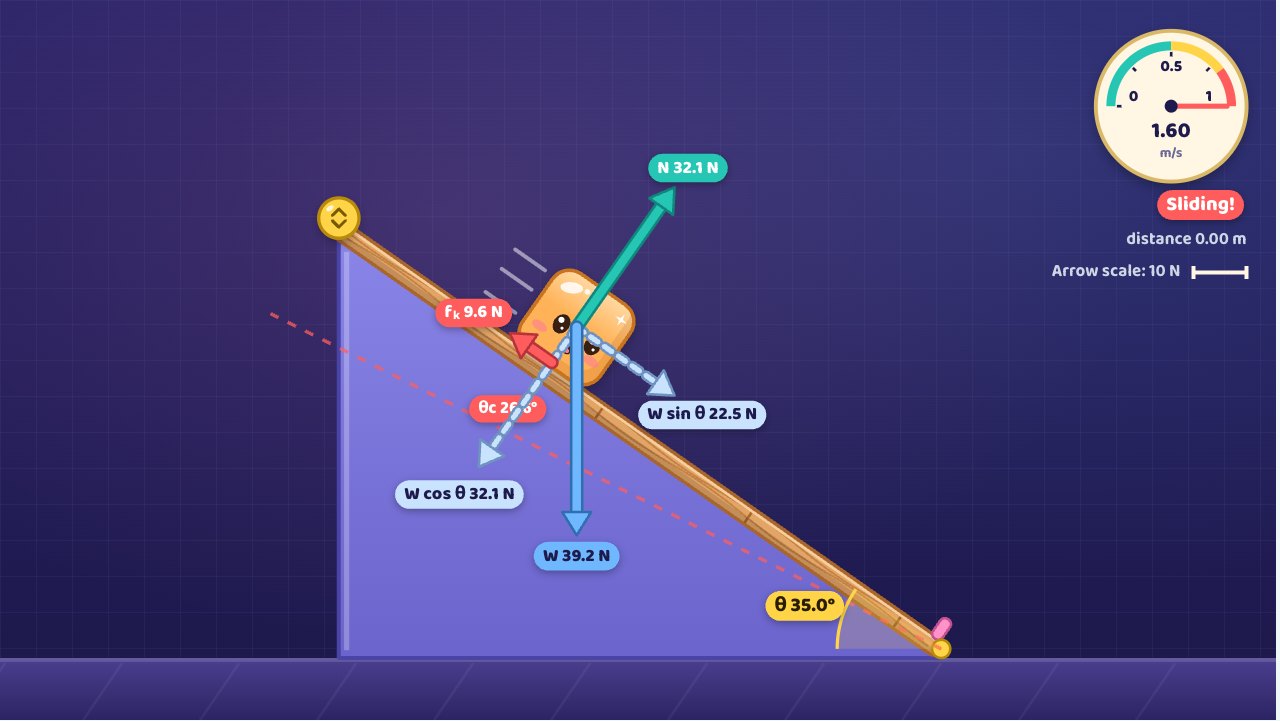
Free, no sign-up, runs in the browser on a projector, TV or touch screen.
Make a review gameFree games library
This simulation puts a box on a ramp in front of the whole class. Tilt the ramp, pick the surface (ice, wood, carpet, sandpaper or rubber), choose the mass and push the box with a slider or with your finger. The box stays where it is while static friction can hold it, then breaks loose and slides, and every force is drawn as an arrow to scale with its value: the weight, the normal force, friction and your push. A speedometer shows how fast it goes, and an experiment tilts the ramp slowly to find the angle where the box starts to slide.
How to use it
- Tilt the ramp: drag the yellow knob at the top of the ramp, use the Angle slider (0 to 60°), or the up and down arrow keys.
- Flat ground: press Flat ground for a level floor. Push harder and harder until the box moves: the starting question in Grade 6.
- Pick a surface: each one has its own static and kinetic friction coefficient, shown in the Numbers panel.
- Push: drag the box like pulling on a rubber band: the further you pull, the harder you push (up to 150 N). Let go and the push stops. The Push slider and the left and right arrow keys set it exactly; Stop pushing or the 0 key sets it back to zero.
- Forces and Components: Forces draws the arrows with their values; Components splits the weight into mg·sin θ along the slope and mg·cos θ into the ramp.
- Experiment: open the Experiment tab and press Tilt slowly. The ramp rises 3° a second from flat, with no push, and the angle where the box slides goes into a table with its tangent.
- On a projector: press full screen; text and buttons grow. Space pauses and R puts the box back.
The forces on a box on a ramp
Four forces act on the box:
- Weight W = mg, straight down. A 2 kg box weighs 2 × 9.81 = 19.6 N.
- Normal force N, from the ramp, at right angles to its surface. On a ramp tilted by θ, N = mg·cos θ, less than the weight.
- Friction f, along the surface, against the way the box moves or would move.
- Your push F, along the ramp, if you push.
The weight is easier to understand in two parts (press Components). One part, mg·sin θ, pulls the box down the slope. The other, mg·cos θ, presses it into the ramp, and the normal force balances it. On flat ground θ = 0, so nothing pulls along the floor and all of the weight presses down. Tilt the ramp and the pull down the slope grows while the pressing gets smaller.
For a 2 kg box at 30°: N = 19.6 × cos 30° = 17.0 N, and the pull down the slope is 19.6 × sin 30° = 9.8 N.
Static and kinetic friction
Static friction acts while the box is at rest. It is exactly as strong as it needs to be to stop the box moving, up to a maximum:
f_static ≤ μs·N
Push gently and friction pushes back just as gently. Push harder and it grows with you. The Numbers panel shows it matching the other forces and the net force staying 0 N.
Kinetic friction acts once the box slides. It has a fixed size, against the motion:
f_kinetic = μk·N
μk is always smaller than μs, so it is harder to start a box moving than to keep it going. On flat wood, a 5 kg box needs more than 0.5 × 49.1 = 24.5 N to start, but only 0.3 × 49.1 = 14.7 N to keep it sliding at a steady speed.
| Surface | μs (static) | μk (kinetic) | Slide angle θc |
|---|---|---|---|
| Ice | 0.10 | 0.05 | 5.7° |
| Wood | 0.50 | 0.30 | 26.6° |
| Carpet | 0.65 | 0.45 | 33.0° |
| Sandpaper | 0.85 | 0.65 | 40.4° |
| Rubber | 1.00 | 0.80 | 45.0° |
These are round values for a wooden box. Real coefficients depend on the materials, how clean and dry they are, and how smooth.
The angle where it starts to slide
With no push, the box starts to slide when the pull down the slope beats the most static friction can give:
mg·sin θ > μs·mg·cos θ, so tan θ > μs
The mass cancels out. A heavy box and a light one start to slide at the same angle, the slide angle θc where tan θc = μs. On wood, tan θc = 0.50 gives θc = 26.6°. This is how friction coefficients are measured in a lab: tilt a plank slowly and read the angle.
How fast it slides
Once moving, the net force is the pull down the slope minus kinetic friction (plus or minus your push), and Newton's second law gives the acceleration:
a = F_net / m = g(sin θ − μk·cos θ)
Again the mass cancels. A 2 kg box on wood at 30° accelerates at 9.81 × (0.5 − 0.3 × 0.866) = 2.36 m/s². At 50° on each surface:
| Surface | Acceleration at 50° |
|---|---|
| Ice | 7.20 m/s² |
| Wood | 5.62 m/s² |
| Carpet | 4.68 m/s² |
| Sandpaper | 3.42 m/s² |
| Rubber | 2.47 m/s² |
Try this
- Flat ground, wood, 5 kg. Raise the push 5 N at a time. At what push does the box start to move? (Just over 24.5 N.)
- Once it slides, lower the push to 20 N. It keeps speeding up, even though 20 N could not start it. Why?
- Experiment tab: find the slide angle for all five surfaces. Compare tan θ with μs in the Numbers panel.
- Change the mass to 10 kg and repeat one surface. Does the angle change?
- Ramp at 40° on wood with no push: the box slides to the bottom. How hard must you push up the ramp to start it moving back up? (mg(sin θ + μs·cos θ) = 2 × 9.81 × (0.643 + 0.383) = 20.1 N for 2 kg.)
Teaching ideas
The simulation fits units on forces and motion: NGSS MS-PS2-2 and HS-PS2-1, KS3 and GCSE forces, AP Physics 1 dynamics.
- Predict (5 minutes): "Will a heavier box start to slide at a smaller angle?" Take a vote, then run the experiment with 1 kg and 10 kg.
- Push (5 minutes): on flat ground, a student pushes the box on the touch screen while the class watches static friction grow with the push, until it lets go.
- Measure (10 minutes): groups take one surface each, find the slide angle, and calculate μs = tan θ. Fill the table on the board.
- Explain (10 minutes): turn on Components and draw the free-body diagram together. Pause at rest and when sliding and compare static and kinetic friction.
- Review (10 minutes): make a review game with the button above and play it as a class, in teams, with your phone as the remote.
Questions teachers ask
What is the difference between static and kinetic friction?
Static friction holds an object that is not moving and adjusts to the push, up to μs·N. Kinetic friction acts on a sliding object and has a fixed size, μk·N. Because μk is smaller than μs, an object is harder to start than to keep moving.
Why doesn't the mass change the slide angle?
A heavier box is pulled down the slope harder, but it also presses into the ramp harder, so friction can hold it more strongly, by exactly the same factor. Both sides of mg·sin θ = μs·mg·cos θ contain m, so it cancels and tan θc = μs.
Are the friction coefficients real?
They are round values for a wooden block inside the ranges physics textbooks give. Real values change with the materials, dust, water and wear, so a real experiment will give slightly different numbers.
Is the motion accurate?
Yes. Between changes the forces are constant, so the simulation moves the box with the exact formulas for uniform acceleration and stops it at the exact moment its speed reaches zero. The test suite checks the forces, the slide angle on every surface and the acceleration against the formulas.
Can students use it on an interactive whiteboard?
Yes. Students drag the box to push it and the knob to tilt the ramp, with one finger each, at the same time. Every button and slider is big enough for a finger.
Do I need to install anything or sign up?
No. It runs in any modern browser, on a computer, a tablet or a phone, and it's free.