Molecule Shapes 3D Simulation (VSEPR)
A free 3D VSEPR simulation for class: add bonds and lone pairs, watch them push apart into the shape, then compare H₂O, NH₃, CH₄, SF₄ and more with real angles.
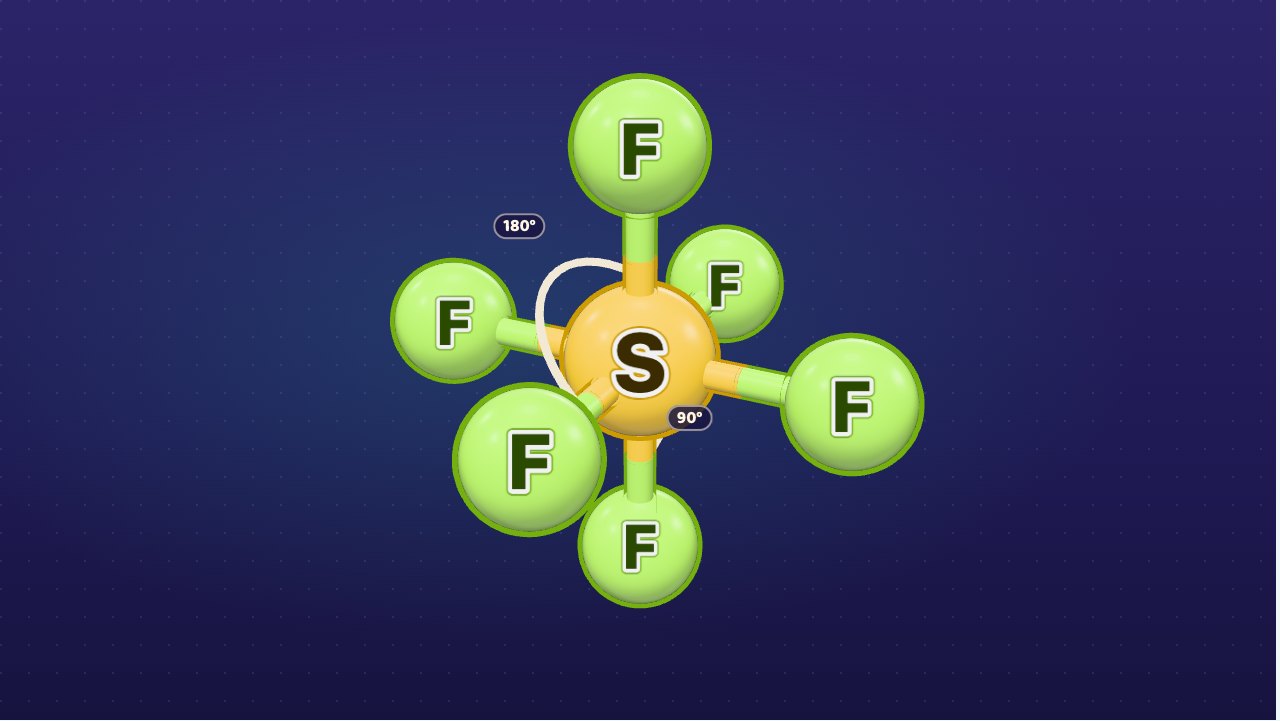
Free, no sign-up, runs in the browser on a projector, TV or touch screen.
Make a review gameFree games library
This simulation puts one molecule in the middle of the screen and lets the class build its shape. Start with a central atom (it has a face, so students remember it is the one in the middle), then add single, double or triple bonds and lone pairs with the buttons. Every electron domain pushes the others away, so they slide over the atom until they are as far apart as they can be, and the panel names what you made: AX₂E₂, tetrahedral arrangement, bent shape, bond angle less than 109.5°. Then switch to Real molecules to see water, ammonia, methane, sulfur tetrafluoride, xenon tetrafluoride and a dozen more with their measured bond lengths and angles, in ball and stick or space-filling.
How to use it
- Build: each button pair adds or removes a single bond, a double bond, a triple bond or a lone pair. The new domain appears in the emptiest place and everything shoves itself into the new arrangement. Up to six electron domains fit round the central atom, and there is always at least one bond.
- Read the panel: the shape's name, its AXmEn formula (A is the central atom, X a bonded atom, E a lone pair), how many electron domains there are, how they are arranged and the ideal bond angles. "< 109.5°" means lone pairs squeeze the angle below the ideal value.
- Real molecules like this: under the explanation, Oly lists real molecules with the same AXE type. Tap one to jump to it.
- Real molecules: pick H₂O, NH₃, CH₄, CO₂, BF₃, SO₂, HCN, C₂H₄, H₂CO, PCl₅, SF₄, ClF₃, XeF₂, SF₆, BrF₅, XeF₄, BeCl₂ or SO₃. The table compares the ideal angle with the measured one, and the arcs on the molecule show the measured values.
- Turn and zoom: drag to turn the molecule, pinch or scroll to zoom. Left alone for a few seconds, it turns slowly by itself.
- Model: Ball and stick shows the bonds (one, two or three sticks) and the angles; Space-filling shows the atoms at their real size, overlapping as they do in the molecule. Labels and Angles switch the element symbols and the angle arcs on and off.
- Keyboard: arrows turn, + and − zoom, 1 and 2 switch modes, B, D and T add a single, double or triple bond, E adds a lone pair (with Shift to remove), Backspace removes the last one, [ and ] change the real molecule, V switches the model.
- Projector: the full screen button in the top right makes everything bigger for the back row. On a touch screen the + and − buttons are big enough for students to tap.
VSEPR in one idea
VSEPR stands for valence shell electron pair repulsion. The electron pairs in the outer shell of the central atom all carry negative charge, so they repel each other and spread out as far as possible round the atom. Two things decide the shape:
- Count the electron domains round the central atom. A domain is a lone pair or a bond to another atom. A double or triple bond counts as one domain, because its electrons all point at the same atom.
- Arrange the domains as far apart as they can be: 2 in a line (180°), 3 in a triangle (120°), 4 in a tetrahedron (109.5°), 5 in a trigonal bipyramid (90° and 120°), 6 in an octahedron (90°). That is the electron arrangement.
- Name the shape from the atoms only. Lone pairs take up space but are invisible in the shape, so a tetrahedral arrangement with one lone pair is a trigonal pyramid (NH₃), and with two lone pairs it is bent (H₂O).
| Domains | Arrangement | No lone pairs | 1 lone pair | 2 lone pairs | 3 lone pairs |
|---|---|---|---|---|---|
| 2 | linear, 180° | linear (CO₂) | |||
| 3 | trigonal planar, 120° | trigonal planar (BF₃) | bent (SO₂) | ||
| 4 | tetrahedral, 109.5° | tetrahedral (CH₄) | trigonal pyramidal (NH₃) | bent (H₂O) | |
| 5 | trigonal bipyramidal | trigonal bipyramidal (PCl₅) | seesaw (SF₄) | T-shaped (ClF₃) | linear (XeF₂) |
| 6 | octahedral, 90° | octahedral (SF₆) | square pyramidal (BrF₅) | square planar (XeF₄) |
Why lone pairs squeeze the bond angles
A lone pair is held by only one nucleus, so it sits closer to the central atom and spreads wider than a bonding pair. It pushes harder: lone pair–lone pair repulsion is the strongest, then lone pair–bonding pair, then bonding pair–bonding pair. The bonds are pushed a little closer together. Methane, with no lone pairs, has the full 109.5°; ammonia, with one, has about 107°; water, with two, has 104.5°.
Double bonds hold more electrons, so they push a little harder too. In ethylene (C₂H₄) and formaldehyde (H₂CO) the H–C–H angle is about 117° instead of 120°.
Five and six domains: where the lone pairs go
In a trigonal bipyramid the places are not all the same. An axial place (top or bottom) has three neighbours at 90°; an equatorial place (round the middle) has only two. Lone pairs need room, so they always take equatorial places first. That is why SF₄ is a seesaw, ClF₃ is T-shaped and XeF₂ is linear. In an octahedron all six places are alike, but a second lone pair goes opposite the first, as far from it as possible: XeF₄ is square planar. The simulation does this by itself: add lone pairs to five domains and watch them slide to the middle.
Try this
- Build AX₄, then turn one bond into a lone pair (remove a single bond, add a lone pair). What is the new shape? What happened to the angle?
- Keep going: two lone pairs, then three. Name each shape before the panel does.
- Make five domains with one lone pair. Turn the molecule: is the lone pair at the top or round the middle? Why?
- Make six domains with two lone pairs. Predict whether the lone pairs end up next to each other or opposite.
- In Real molecules, compare CH₄, NH₃ and H₂O. Put the measured angles in order and explain the pattern.
- Compare CO₂ and SO₂: both have two double bonds to oxygen. Why is one straight and the other bent?
Teaching ideas
The simulation fits the chemical bonding unit of high school chemistry: Lewis structures, VSEPR and molecular shape, and molecular polarity. It supports AP Chemistry's unit on molecular and ionic structure (VSEPR and bond hybridization), IB Chemistry's structure 2.2 on the covalent model, and the shapes of molecules in A-level Chemistry. In the NGSS it supports HS-PS1-3 (structure at the bulk scale from forces between particles) when you go on to polarity and boiling points.
- Warm-up (3 minutes): show water in space-filling. Ask: "Why isn't water a straight line, H–O–H?"
- Build the families (10 minutes): start from AX₂ and add domains one at a time up to AX₆. The class names the arrangement before you press +, then checks the panel.
- Lone pairs (10 minutes): from AX₄, swap bonds for lone pairs one by one. Draw the Lewis structures of CH₄, NH₃ and H₂O on the board and match each to its shape.
- Real angles (7 minutes): in Real molecules, read the measured angles of CH₄, NH₃, H₂O and SO₂. Ask students to explain each difference from the ideal angle.
- Expanded octets (8 minutes, for older classes): PCl₅, SF₄, ClF₃, XeF₂, SF₆, BrF₅ and XeF₄. Ask where the lone pairs are before you show each one.
- Review: make a review game: the whole class plays on the same screen in teams, with your phone as the remote.
Questions teachers ask
Why does a double bond count as only one electron domain?
All the electrons of a double or triple bond lie between the same two atoms, so they point in one direction and behave as one region of electron density. VSEPR counts regions, not electrons: CO₂ has two domains (two double bonds) and is linear, just like BeCl₂ with two single bonds.
Are the angles in Build real?
The arrangement and the ideal angles are exactly the VSEPR ones. When there are lone pairs, the bonds lean a few degrees away from them to show the trend, and the panel says "< 109.5°" rather than a number, because the real angle depends on the atoms. The numbers in Real molecules are measured values for each molecule in the gas phase.
Why is the ammonia angle 107°, not 106.7°?
The precise measured value is 106.7°; most textbooks round it to 107°, so the simulation shows 107° to match what students read. All the other values are rounded from the same database of experimental geometries.
What do the colours mean?
The real molecules use the usual CPK colours: hydrogen white, carbon dark grey, nitrogen blue, oxygen red, fluorine pale green, chlorine green, sulfur yellow, phosphorus orange, bromine dark red. In Build, the central atom is yellow, the bonded atoms blue and the lone pairs pink.
Does it explain polarity?
Not directly, but it is a good start. Once students see that CO₂ and BF₃ are symmetric and H₂O and NH₃ are not, ask which molecules have their bond dipoles cancel. That is the next lesson.
Does it work on an interactive whiteboard?
Yes. Students can drag the molecule with a finger and pinch to zoom, and the + and − buttons are big enough to tap. Full screen makes the panel readable from the back row. It also works on a phone. Nothing to install and no sign-up: it runs in the browser and it's free.