Waves and Sound Simulation
A free sound wave simulation for class: see air particles and the pressure graph, change frequency and amplitude, hear the tone, compare sounds, pluck a string.
Free, no sign-up, runs in the browser on a projector, TV or touch screen.
Make a review gameFree games library
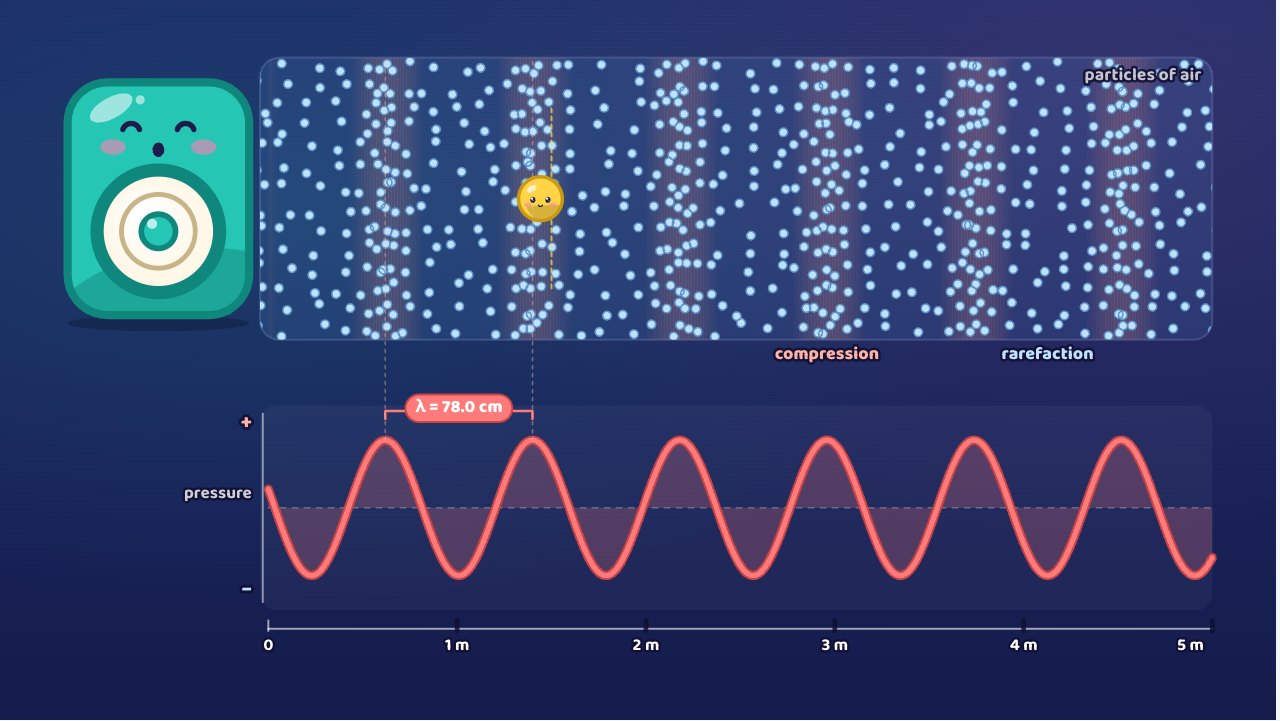
This simulation puts a cute speaker in front of the whole class and lets everyone see the sound it makes. The same wave is drawn two ways at once: as particles of air crowding together and spreading apart, and as the pressure graph underneath, lined up on one ruler so the class sees that every peak of the graph is a crowd of particles. Change the frequency and the amplitude, switch the medium to water, steel or a vacuum, and press Sound on to hear the real tone. Compare puts two sounds side by side, and String plucks a guitar string whose pitch follows its length and tension.
How to use it
- Frequency: use the Frequency slider (20 Hz to 2000 Hz on a log scale), or a preset: a bass drum (60 Hz), someone speaking (200 Hz), the A on a piano (440 Hz) or a whistle (1500 Hz). Keys 1 to 4 pick the presets.
- Amplitude: the Amplitude slider (10 % to 100 %) sets how far the particles move, which is how loud the sound is. The Numbers panel gives the level in decibels.
- Drag the graph: sideways stretches or squeezes the wave (lower or higher pitch), up and down makes it louder or quieter. With the keyboard: left and right arrows change the frequency, up and down the amplitude.
- Medium: Air, Water and Steel each have their own speed of sound, so the same tone has a different wavelength in each. Vacuum puts the speaker under a bell jar with the air pumped out: it still vibrates, but no sound comes out.
- Sound on: plays the tone through your speakers, quietly, with a gentle fade. It is off until you press it, follows the sliders, and goes silent in a vacuum. S switches it on and off.
- Compare: two speakers, A and B, with their waves on one graph. Pick which one the sliders change. The panel says how many times higher B's frequency is and how many decibels louder or quieter it is.
- String: drag the string and let go to pluck it, drag the coral finger to make the string shorter, and set the tension and the thickness. The frequency and the nearest musical note update as you go.
- On a projector: press full screen; text and buttons grow. Space pauses, and the round arrow starts the wave again from the speaker.
The picture is slowed down so the motion is readable: a real 440 Hz tone vibrates 440 times a second, far too fast to see. On screen the wave runs about 300 times slower (the Numbers panel shows by how much). A higher pitch still moves faster on screen, and every number in the panel is the real one.
How sound travels
Sound is a vibration passed from particle to particle. The speaker's cone pushes the air next to it, those particles push their neighbours, and so on. Each particle only moves a little way back and forth around its own place (follow the yellow particle with a face), but the pattern of pushes travels all the way across the room.
Where the particles crowd together the pressure is a little higher: a compression. Where they spread out it is a little lower: a rarefaction. Because the particles move back and forth along the direction the sound travels, sound is a longitudinal wave. The graph underneath plots the pressure along the way, which gives the familiar wave shape, the transverse picture of the same wave: a peak of the graph is a compression, a valley is a rarefaction.
Sound needs a medium (a solid, a liquid or a gas) to travel through. In a vacuum there are no particles to push, so there is no sound at all, however hard the speaker vibrates.
Frequency, period and wavelength
- Frequency f is how many vibrations happen each second, in hertz (Hz).
- Period T is the time for one vibration: T = 1/f.
- Wavelength λ is the distance from one compression to the next. It depends on how fast sound travels in the medium, v: λ = v/f.
| Sound | Frequency | Period | Wavelength in air |
|---|---|---|---|
| Bass drum | 60 Hz | 16.7 ms | 5.72 m |
| Speaking | 200 Hz | 5.00 ms | 1.72 m |
| Piano A | 440 Hz | 2.27 ms | 78.0 cm |
| Whistle | 1500 Hz | 0.67 ms | 22.9 cm |
Double the frequency and the wavelength halves, because the speed stays the same. In a faster medium the waves are stretched out. The same 440 Hz tone:
| Medium | Speed of sound | Wavelength at 440 Hz |
|---|---|---|
| Air (20 °C) | 343 m/s | 78.0 cm |
| Water | 1480 m/s | 3.36 m |
| Steel | 5900 m/s | 13.4 m |
| Vacuum | no sound | no wave |
Pitch and loudness
Pitch is how high or low a sound is, and it depends on the frequency: the higher the frequency, the higher the pitch. Loudness depends on the amplitude: the bigger the amplitude, the louder the sound.
Loudness is measured in decibels (dB). Comparing two sounds, the difference in level is
L₁ − L₂ = 20·log10(A₁/A₂)
Half the amplitude is 6 dB quieter, a tenth of the amplitude is 20 dB quieter. In the simulation the level is relative: 0 dB is the loudest setting, so 50 % reads −6.0 dB and 10 % reads −20 dB. Real sound levels, from a whisper (about 30 dB) to a rock concert (about 110 dB), use the same rule from a fixed starting point.
The hearing range
People hear from about 20 Hz to 20,000 Hz, and the top end drops with age. Sound below 20 Hz is infrasound: elephants rumble to each other with it, and earthquakes make it. Sound above 20,000 Hz is ultrasound: bats and dolphins find their way with it, and hospitals use it to look inside the body. The bar in the Numbers panel shows where the chosen sound sits.
The vibrating string
A guitar string is fixed at both ends, so it vibrates with a transverse wave that fits exactly half a wavelength between them: λ = 2L. The wave travels along the string at v = √(T/μ), where T is the tension and μ the mass of one metre of string, so the frequency is
f = v/2L = (1/2L)·√(T/μ)
- Shorter string, higher note: half the length, double the frequency (one octave up). That is what a finger on a fret does.
- Tighter string, higher note: four times the tension doubles the frequency. That is how a guitar is tuned.
- Thicker string, lower note: a heavier string vibrates more slowly.
The thin string at 65 cm and 72 N gives 326 Hz, close to E4, the top string of a guitar. The string makes the guitar body vibrate, and the body pushes the air: the sound reaching your ear is a longitudinal wave again.
Try this
- Press Sound on and slide from 20 Hz to 2000 Hz. Which sounds can you hear? Where does the pitch become uncomfortable?
- Pick the bass drum and then the whistle. How many times longer is the drum's wavelength? (1500 ÷ 60 = 25 times.)
- Keep 440 Hz and switch from air to water to steel. What changes and what stays the same? (The wavelength changes, the frequency and the period do not.)
- Switch to Vacuum with the sound on. What happens, and why does the speaker still move?
- Compare: set B to half the amplitude of A. How many decibels quieter is it? Then set B to twice A's frequency: what happens to its wavelength?
- String: find two ways to raise the note by one octave.
Teaching ideas
The simulation fits units on waves and sound: NGSS MS-PS4-1 and MS-PS4-2 (a wave model with amplitude, wavelength and frequency), HS-PS4-1 (v = fλ), KS3 sound and GCSE waves.
- Predict (5 minutes): "If the pitch goes up, will the wavelength get longer or shorter?" Take a vote, then slide the frequency.
- Two pictures, one wave (10 minutes): pause the wave and ask a student to point at a compression in the particles, then at the same place on the graph. Follow the yellow particle: does it travel to the other side?
- Measure (10 minutes): groups take one preset each, read the wavelength off the ruler with the λ bracket, and check it with λ = v/f.
- The bell jar (5 minutes): switch to Vacuum. Why can astronauts not talk to each other in space without a radio?
- Review (10 minutes): make a review game with the button above and play it as a class, in teams, with your phone as the remote.
Questions teachers ask
Is sound a longitudinal or a transverse wave?
Sound in air is longitudinal: the particles move back and forth along the direction the sound travels. The graph of pressure looks like a transverse wave, which is why the simulation draws both and lines them up. A guitar string, on the other hand, carries a transverse wave: it moves at right angles to its length.
Why is the animation so much slower than real sound?
A 440 Hz tone vibrates 440 times every second; drawn at real speed it would be a blur. The picture runs a few hundred times slower, and higher pitches still move faster on screen. The frequency, period, wavelength and level in the panel are the real values.
Why does the wavelength change in water but not the frequency?
The frequency is set by the source: the speaker vibrates the same number of times a second whatever it pushes on. Sound travels about 4.3 times faster in water than in air, so each vibration spreads 4.3 times further before the next one: λ = v/f.
What do the decibels in the simulation mean?
They compare the current amplitude with the loudest setting: 0 dB is 100 %, −6 dB is half the amplitude, −20 dB a tenth. Real sound levels use the same 20·log10 rule, measured from the quietest sound people can hear.
Is the sound safe for the classroom?
The tone starts only when you press Sound on, fades in and out gently, and its volume is capped. Low and high tones can still be unpleasant for some students, so keep your device's volume low and stop it with the same button or the S key.
Do I need to install anything or sign up?
No. It runs in any modern browser, on a computer, a tablet or a phone, and it's free.